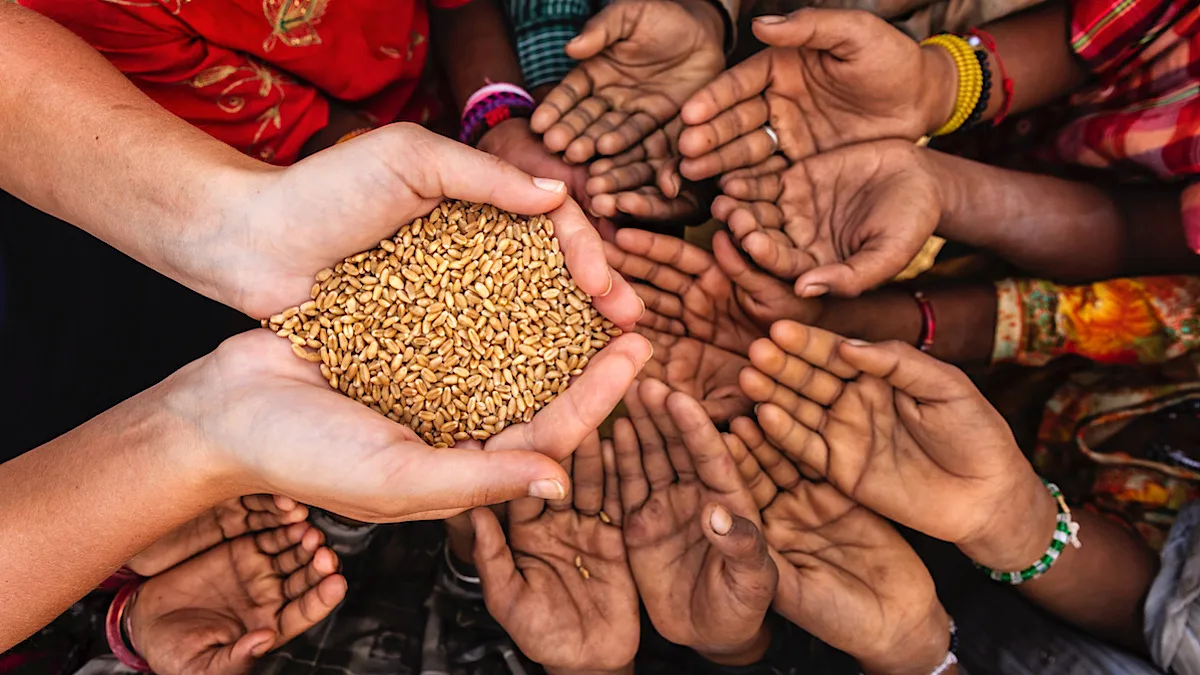
A tragic paradox is that even while democracies are apathetic to mass starvation, they downplay and ignore the fact that the hundreds of million children and adults continue to lead lives of severe undernutrition (hidden hunger) since it hardly provokes a public outcry. A democratic government cannot afford to ignore the public outcry. Hence, India’s success in preventing a famine during the period since 1947 can be attributed to the inherent force of democracy.
But its overall record in fighting hunger and malnutrition seems to be quite abysmal. Indeed, the “hungry India” situation is characterized by high levels of undernutrition and child malnutrition, particularly stunting and wasting, with its Global Hunger Index (GHI) ranking in the serious category. For millions of people in India, hunger is an unremitting way of life; insidious, furtive and unforgiving. It lurks not just in the teeming countryside but also in the shadows of glittering cities.
Advertisement
The poor response of governments is well documented. The cruel irony is that widespread hunger is reported in parallel with abundant foodgrains. Citizens get deprived of their due share while food stocks rot in the absence of proper storage facilities. Between 190 million and 200 million people in India go to bed hungry every night. Pathetically, when the wailing of hungry infants gets too much, their hungry and hapless mothers give their fingers laced with tobacco or natural intoxicants to suck, and to help them sleep at night. The painful paradox is that while wedding halls and restaurants see food wastage every single day, children in classrooms struggle to focus with their empty stomachs and hunger pains. According to the National Family Health Surveys, India has constantly been flagged as a country where nutrition gaps remain alarming despite it being one of the largest producers of food in the world.
To explain he situation Nobel laureate Amartya Sen has aptly mentioned in his book entitled Poverty and Famines: “Starvation is the characteristic of some people not having enough food to eat. It is not the characteristic of there not being enough food to eat.” Hunger is of two types: overt hunger and hidden hunger. Overt hunger necessitates filling of stomachs at regular intervals, while hidden hunger alludes to micronutrient deficiency that is fundamental in consumption of a limited quantity for the human body as well as inadequate intake of protein and calorie. This is persistent (endemic).
Indeed, there has been a drastic decline in self-reported hunger in India ~ from around 16.1 to 1.9 per cent between 1983 and 2004-05 ~ which implies a decline in food insecurity. But inadequate calorie consumption is closely linked to the socio-economic status (SES) and health status of a nation. However, to measure a nation’s progress and also to evaluate its hunger status, a standard method, Global Hunger index (GHI) has been evolved. The GHI is a statistical tool for comprehensively measuring and tracking hunger at global, regional, and national levels, reflecting multidimensional hunger over time. It has been developed and adopted by the International Food Policy Research Institute (IFPRI).
The GHI score based on the values of four component indicators (undernourishment, child stunting, child wasting and child mortality) is calculated on a 100-point scale reflecting the severity of hunger, where 0 (zero) is the best possible score (no hunger) and 100 is the worst. Each country’s GHI score is classified by severity, from low (GHI value <= 9.9), moderate (10.0-19.9), serious (20.0–34.9), alarming (35.0-49.9) to extremely alarming (GHI value >= 50.0). GHI 2025 marks an anniversary by taking stock of two decades of evidence-based recommendations: moving from productivity-focused agriculture toward right-based, inclusive and resilience-oriented approaches.
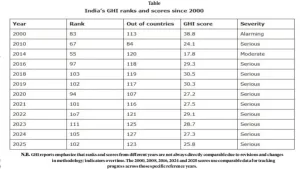
India ranks 102nd out of 123 countries in the 2025 GHI report with a “serious “GHI score of 25.8. India’s rank in the GHI has varied over the years as revealed from the following table India faces a significant challenge in addressing hunger, particularly when measured against GHI. Malnutrition affects a person throughout his/her life cycle. A malnourished child becomes a malnourished adolescent and then an adult with hampered physical, cognitive and productive capacities. Around 24 per cent of Indian adolescents are thin and around 80 per cent suffer from multiple micronutrient deficiency (hidden hunger). It is quite evident that women are the worst affected by hunger because the patriarchal structures of families in India teach them to go hungry, when food is scarce. The social structures compel our women to live with starvation. It deserves mention that adolescent women are not only the future workforce but also bearers of the next generation. In the areas marked by higher levels of undernutrition, malnourished women or adolescent girls give birth to babies that are born stunted and thin. In this way, undernutrition is handed down from one generation to another as a terrifying inheritance. Children of malnourished mothers do not experience much catch-up growth in subsequent years.
As a result, the country will not only be unable to reap the gain of demographic dividend but also suffer from the vicious cycle of malnourishment. The 2025 GHI index score and ranking reveal that approximately 13.7 per cent of the Indian population is undernourished. Stunting is high at 35.5 per cent, wasting at 18.7 per cent and the under-five mortality rate is 2.9 per cent. India is home to about one quarter of the world’s hungry people, with over 190 million undernourished. Thus, we witness that hidden hunger, a silent epidemic, perpetuates the cycle of poverty, poor nutrition, lost productivity, and dismal economic growth. The other end of the malnourishment spectrum is caused mainly by excessive intake of calories. It is called obesity, meaning that a person’s weight is much too high for his/her height. It speaks volumes of the prevailing inequality in our society. Hunger is not just the outcome of a lack of food.
It is the product of an intricate network of social, political and economic issues. The country successfully implemented the green revolution in the mid-1960s. In terms of food production, the country ranks second in the world, following only China. But there remain distribution problems within the country which are increasing day by day. The immediate cause of hunger is poverty. In other words, this indicates poor access to food, the inability of poor households to earn a consistent income for purchasing adequate and nutritious food. According to the World Bank, a major percentage of India’s population continues to earn below Rs. 100 per day. With rising inflation and job insecurity, the majority of households are feeling constrained to survive.
Access to healthy food is necessary to tackle existential and economic challenges of a malnourished generation. To achieve SDG-2 (no hunger) in India, existing programmes must be thoroughly implemented. Nobel laureate Norman Borlaug said: “The most essential component of social justice is adequate food for all mankind. Food is the moral right of all who are born into the world.”
(The writer is a retired IAS officer)