Graduating from “Vishwamitra” to “Vishwamitra Doctrine”
India’s rising stature in the geopolitical arena, coupled with its burgeoning economic and military strength, necessitates a strategic rethink in how it perceives and secures its interests.
Srikumar Bharathi P | New Delhi | November 15, 2025 10:27 am
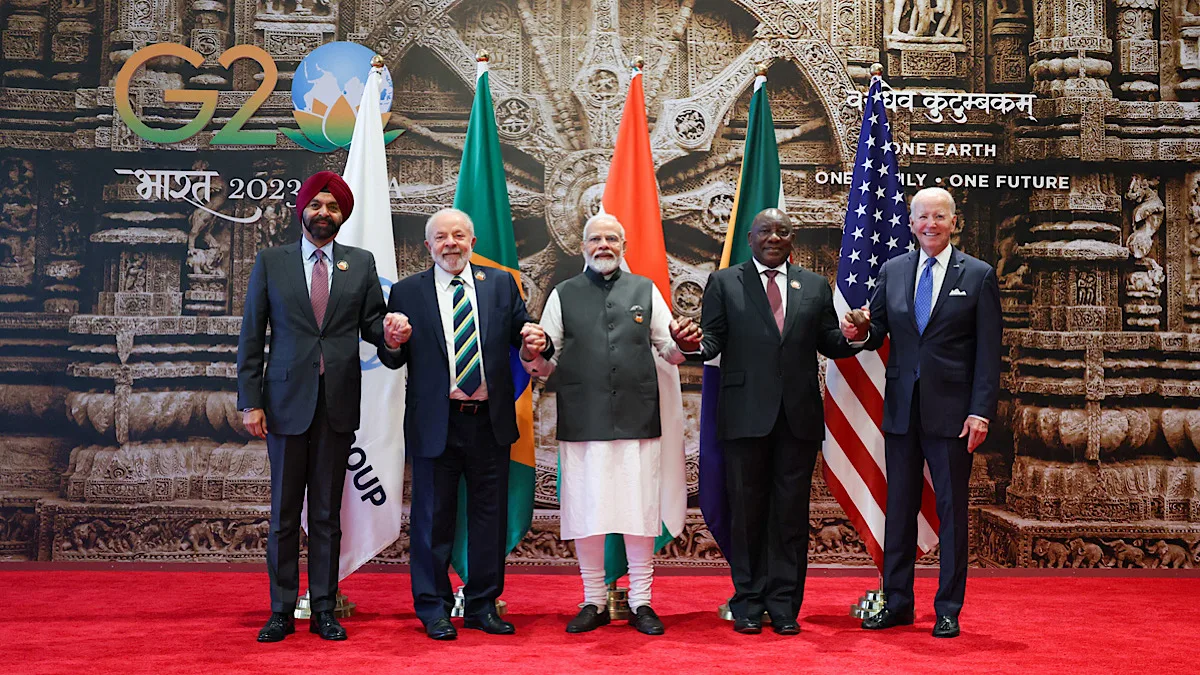
G20 summit (Photo:PIB)
India’s rising stature in the geopolitical arena, coupled with its burgeoning economic and military strength, necessitates a strategic rethink in how it perceives and secures its interests. In the present multi-polar world marred with Wars & Trade-wars, the time has come to graduate from ‘Vishwamitra – a token terminology’ to ‘Vishwamitra Doctrine’ which would be a foundational pillar for Viksit Bharat’s national security interests.
Vishwamitra Doctrine: India’s Role in a Changing World
Advertisement
The term “Vishwamitra” implies as friend of the world, an ancient Bhartiya philosophy that India is increasingly embracing in its geopolitical engagements. The present emergence of India is driven by its economic and technological strengths, with special focus on its defence capability. Also, the country’s external engagements have become independent and assertive in the recent years. Under such a spectrum, a doctrine is necessary which mandates to build enough capability there by securing own interests, deterring conflicts and provide net security in the region. Rather this has been the case historically, where India has been a powerhouse of knowledge, technology, economy and defence. But this prowess dwindled for about past few centuries. However, the country has now unshackled its past and is moving in the right direction to re-establish itself in the global arena. This strategic glidepath needs to be backed up with a doctrine to ensure certain Influence Projection capabilities which would prevent conflicts.
Advertisement
Forging Strategic Capabilities
India’s commitment to protecting its economic, strategic interests and that of friendly foreign nations, along with ensuring the security of its citizens abroad, requires a credible and reliable defence capability. The Vishwamitra doctrine needs an outreach capability that can be used as a tool for creating buffers. The changing dynamics of global politics, conflicts and piracy in the Arabian-Red Seas, emphasise the need for focus on certain capability developments. India’s defence forces have demonstrated their capability through various missions, including Humanitarian Assistance and Disaster Relief (HADR), counter piracy operations and rescue operations of Indian nationals overseas. The success of any geopolitical doctrine is dependent on tangible, credible and reliable capabilities which can fulfil the expected commitments. Under this ambit, through Vishwamitra Doctrine, Theatrisation in the Indian Armed Forces would be the first prudent option, which would ensure the necessary capability enhancements.
Facing future challenges necessitate capability augmentation in terms of marine and airborne capabilities of the country. An augmentation of capabilities from the existing structure of the Amphibious and Airborne pillars of the defence forces is a step in the right direction, which can later be amalgamated with the envisaged Theatre Command frame work. Such capability would provide India a strategic asset capable of swift engagement, in contingencies ranging from securing vital locations to enhancing leverages in distant theatres. It would serve as a powerful tool in preventing conflicts thereby advancing India’s strategic objective of Vishwamitra.
Buffer Creation Across Domains
In the contemporary geopolitical environment, the traditional territorial buffers are important, yet they are insufficient in the modern interconnected world. Under the visualised doctrine, apart from territorial buffers, advocacy for creating buffers across three key domains stands prime, Geospatial, Economy & Technology. These buffers serve to insulate India from hostile external pressures and provide strategic depth in non-kinetic conflicts.
Geospatial DomainCreating a buffer in the geospatial domain involves establishing a layered security architecture that extends beyond physical borders. This includes robust surveillance and situational awareness, coupled with Integrated Missile Defence Systems and Information Warfare Capabilities. Investing in advanced satellite constellations, long-range radar systems, and cyber intelligence need to be the focus areas. Further, the geospatial domain requires instituting of organisations for building a resilient Cyber and Information Warfare capability to respond to cyberattacks, protect critical digital infrastructure and project power in the information domain. A strong geospatial buffer enhances India’s security by denying adversaries operational space and ensuring the integrity of its territorial and digital sovereignty.
Economic Domain At present, Indian economy is hitting new highs, yet it is important to diversify and establish enmeshed economic tie-ups with key partner countries that align with own economic, trade glidepath through Strategic Trade Agreements. Investing in connectivity infrastructure, developing regional connectivity projects, including transport corridors, port development, and energy pipelines, to facilitate seamless trade flows and reduce dependence on single routes or partners. The enhancements in trade proportion necessitate maintaining of safe sea lines of communication and secure port zones for own trade activity in partner foreign nations. Further, by setting National Missions for diversifying supply chains and promoting domestic manufacturing, the desired end-state of reducing reliance on single source for critical goods can be achieved.
Technology Domain Critical Technology and rare earth mineral resource spectrum is a key domain that needs to be secured and backed up with buffers. With more Indian Public Sector Undertakings and Private companies foraying into new markets across continents for these resources, it is mandatory to develop capabilities for placing such ventures under the own security umbrella. Buffers can be created for Critical Technology security, by ensuring mutual stakes and co-partnering, to ensure resilience against external shocks.
Srikumar Bharathi P
The alignment of Vishwamitra Doctrine is to maintain strategic autonomy with assuring of mutually respected relationships and partnerships with geopolitically aligned countries. The focus on Global South must be a mandate and engagement with such partner countries by application of above-mentioned capabilities would ensure equitable global governance, there by fostering goodwill and diversification. The time has arrived for India to graduate to the Vishwamitra Doctrine with serious capability developments to project itself as a transformative power across domains, as this doctrine acknowledges the complexities of the modern world. It advocates for a comprehensive strategy encompassing military modernisation, geospatial dominance, economic influence and diplomatic outreach to attain the cherished goal of Viksit Bharat by 2047.
( The Author is a serving officer in the Indian Army with experience in Counter Terrorism and United Nations Peace Keeping operations. The officer has authored a book on China and has been a regular contributor of articles on matters of Strategy, Defence and Geo-Politics.)
Disclaimer – The views expressed, suggestions made & quoting of prominent personalities in the article are solely the responsibility of the author and do not have any official endorsement.
Operation Amistad, India’s Humanitarian Assistance and Disaster Relief (HADR) mission launched following the devastating earthquakes in Venezuela, concluded successfully with the return of the Indian contingent to New Delhi on Friday.
Addressing graduating cadets at the NDA’s Khetarpal Parade Ground in Khadakwasla, General Upendra Dwivedi termed Operation Sindoor as a defining example of India’s military response doctrine in the face of provocation.