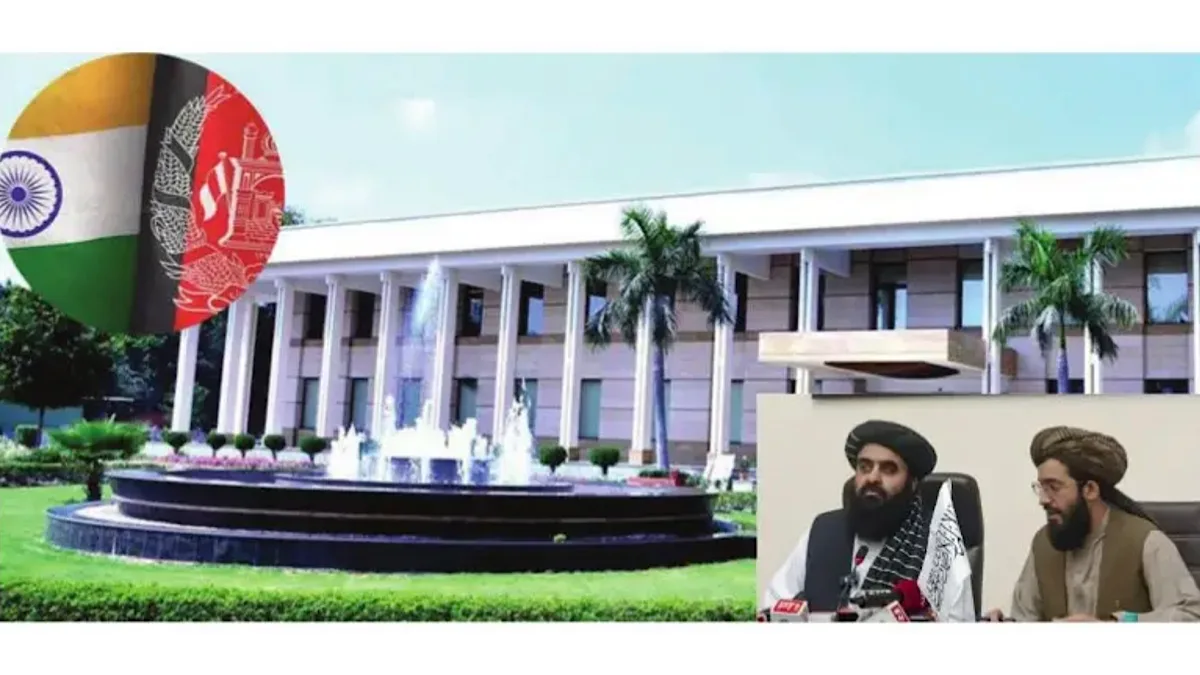
Much hullabaloo was made of Afghanistan’s acting Foreign Minister, Mawlawi Amir Khan Muttaqi’s press conference at the Afghan Embassy, where women journalists were disallowed. While India’s Ministry of External Affairs (MEA) clarified that it had no role in organizing the press interaction, there was widespread criticism of Delhi’s supposed acquiescence of gender discrimination. Civil society, journalists, and opposition leaders, called out the Taliban government’s discriminatory act.
Firstly, the Vienna Convention on Diplomatic Relations (1961) grants privileges and immunities that extend to invitations and accesses to embassies in any host country. So technically, the Afghanistan Embassy in Delhi was well within its right to filter the audience that it sought to engage with its Foreign Minister, however picky it was in making those choices. If gender was the discriminatory factor here, one can only imagine the sort of filters that an Embassy of say Israel, China, or North Korea, would deploy whilst planning engagement with their respective authority figures in Delhi. It is highly unlikely that a Tibetan or even a journalist from the Indian State of Arunachal Pradesh would get invited to the Chinese Embassy in Delhi.
Advertisement
Importantly, Muttaqi did make amends quickly and included women journalists in his second press conference. He unconvincingly attributed the earlier exclusion to “short notice.” The implausible “short notice” notwithstanding, the fact that he denied the charges of gender discrimination and made the necessary inclusions subsequently must be lauded, especially coming from a representative of a regressive, puritanical, and hyper-religious regime like the Taliban. If anything, Muttaqi chose to acquiesce to the “normalcy” of the host nation as opposed to insisting on the known sensibilities of his own government. The diplomatic adjustment and compromise ultimately came from Muttaqi’s side.
This subsequent correction does not condone the sweeping restrictions on women re-imposed by the Taliban in their second tenure. From banning education for a girl child beyond the sixth grade, banning employment in government or relief jobs, legal or political diminishment, or even restricting access to healthcare and social mobility ~ the psychological, physical, and social discrimination against women in Afghanistan is abysmal. It is at complete variance to the societal and constitutional status of women in India. But then India has had evolutionary changes and reforms over time, whereas the complex and perennially wounded history of Afghanistan has not been afforded the same progressive transformation.
If the subcontinent’s fight against the British colonists was rooted in a secular movement (till a very late stage) and subsequent constitutionality, the local Afghan fight against the foreign powers, be it against the the British, Soviets, or the Americans, was always rooted in feudal/tribal pride or religiousity (Jihad). There are civilisational (violent land of the “Great Game”), cultural-tribal, and even religious reasons for the Afghan narrative to remain unevolved, even today. However, diplomacy necessitates focusing on commonalities, rather than on differences, in the hope that the larger outcomes lead to betterment, even if they are still far from perfect. For India to only focus on Taliban’s obvious wrongs would only perpetuate the divide and worsen portents, whereas engagement and interaction could lead to possibilities of positive changes for India (and Afghanistan), in every realm.
Even purely from realpolitik, a friendly Afghanistan denies Pakistan its long cherished “Strategic Depth” in Afghanistan. Besides obvious economic and strategic opportunities (e.g., gateway to Central Asia via the Chabahar port in Iran) – the Indian footprint in Afghanistan cuts into the possible influence of China and positions Delhi as the global pointsman for Afghanistan to the rest of the world. The cultural and societal affinity towards India and Indians in Afghanistan, as opposed to perceptions of Pakistanis, Chinese, Iranians, Russians or even the Americans, is unmatched. Delhi must cash in on that positivity for itself and use that lever for “normalising” and positivizing Taliban’s outlook, especially for its vulnerable sections. But by not engaging, Delhi also denies the Afghan populace under Taliban that possible opportunity to “open up” and reform. India does (and must) continue engaging with nations it has disagreements with, be they societal or governmental.
India actively engages with many Arab Sheikhdoms with “normalcies” that are at stark variance with Indian society or even having complicated sovereign positions on sensitive issues like J&K. India does invest heavily with Israel even though Delhi’s position on Palestine is at variance with that of the current dispensation in Tel Aviv. Similarly, Delhi has strong relations with an undemocratic and authoritarian regime in Moscow; just as we may or may not have similarly warm relations in Bangladesh or Nepal, even with the democratic free will of its people (despite cultural, civilisational or religious commonalities). There is simply no alternative to engagement, even if one were to disagree on certain aspects of the other side. India needs to engage confidently with the conviction that it has had women Presidents, Prime Minister, Foreign Minister, Foreign Secretaries, eminent Journalists and Editors (e.g., of this very publication), all on account of their merit.
India can teach by inspiring examples and not necessarily by preaching or denialism. If anything, in recent times it has conveniently forsaken engagement selectively with Pakistan (ironically not with China, its foremost enemy) as publicly decrying Pakistan has electoral gratification in domestic politics. However, when a financial “deal” is attractive (read, BCCI stakes), it readily plays cricket matches with Pakistan with public postures of no handshakes – this is convenient, partisan and amnestic nationalism, which is inconsistently flexed depending on situations.
If we can rightly thaw relations with the Taliban (whilst disagreeing with many of their moorings), we can similarly engage with other neighbours if we can conduct diplomacy shorn of the electoral lens. If engagement with Xi Jinping (despite the bloody Summer of 2020) and Taliban is kosher and conditional, it can also be with yet another troublesome neighbour across the Line-of-Control. Non-engagement is sheer partisanship as Atal Behari Vajpayee, the doyen of the current persuasion, famously said, “You can change friends but not neighbours”, while insisting on engagement with Pakistan. Differences and electoral calculus must not mix with diplomacy
(The writer is Lt Gen PVSM, AVSM (Retd), and former Lt Governor of Andaman & Nicobar Islands and Puducherry)