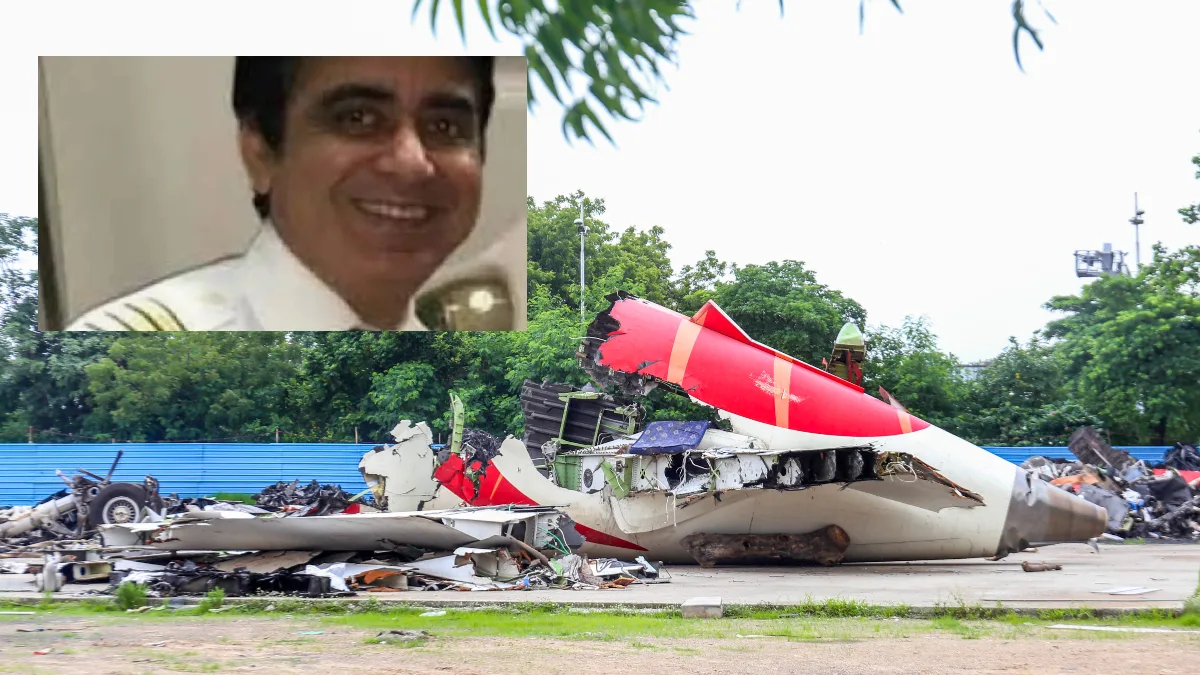
The Supreme Court on Friday issued notice to the Centre, the DGCA and others on a plea filed by the father of late Captain Sumeet Sabharwal, who was the Pilot-in-Command of the Air India plane involved in a June crash in Ahmedabad that killed 260 people.
The plea filed by the deceased captain’s father sought a retired judge-monitored fair, transparent, and technically sound probe into the crash of Air India Boeing 787-8 Dreamliner aircraft.
Advertisement
“Unfortunately, this crash took place, but you (father) should not carry this burden that your son is being blamed… Nobody can blame him (pilot) for anything,” stated the apex court.
“No one in India believes it was the pilot’s fault,” says Justice Surya Kant.
The petition, filed by 91-year-old Pushkaraj Sabharwal along with the Federation of Indian Pilots (FIP), had called for the constitution of a court-monitored committee, headed by a retired Supreme Court judge, comprising independent aviation experts, to ensure a fair, transparent, and technically sound inquiry into the incident.
The plea had contended that the ongoing probe conducted by the Ministry of Civil Aviation and the Directorate General of Civil Aviation (DGCA) — and its preliminary report dated June 15 — is “defective, perfunctory, and suffers from serious infirmities and perversities.”
The plea had sought that the DGCA’s probe and preliminary report be declared closed, and that all relevant records, data, and materials be transferred to the proposed independent committee or a new court of inquiry.
“Respondents have conducted a perfunctory, biased, and technically deficient investigation into the crash of Air India Boeing 787-8 Dreamliner (VT-ANB), ignoring critical inconsistencies, material evidence, and plausible systemic causes, thereby undermining the credibility of the inquiry,” the petition stated.
The petitioners have alleged that the DGCA prematurely attributed the crash to pilot error, without a comprehensive technical analysis or corroborative evidence. Such a conclusion, they argue, is “arbitrary, perverse, and violative of Articles 14 and 21 of the Constitution of India.”
According to the plea, the preliminary report had suffered from serious technical flaws and omissions, failing to adequately examine key aspects such as the deployment of the Ram Air Turbine (RAT), the potential failure of Boeing’s Common Core System (CCS), and the simultaneous loss of multiple redundant safety and data systems — all of which point to a systemic electrical failure rather than pilot error.
It had also asserted that the finding of pilot error is “inherently implausible and contrary to the recorded flight data, since RAT deployment occurred before any manual input by the crew.” The plea added that the failure to correlate crew actions with RAT extension demonstrates “non-application of mind and suppression of material facts,” violating the principles of a fair and evidence-based investigation.
The petition had further claimed that investigators ignored possible design-level or software integration failures within the Boeing 787’s CCS, despite prior expert warnings regarding cascading failures. “The omission to conduct independent software forensic analysis or fault-injection testing vitiates the integrity of the findings and defeats the purpose of an independent technical inquiry envisaged under Annexe 13 of the Chicago Convention,” the plea had concluded.
AAIB had released a preliminary report on July 12, a month after the air accident at Ahmedabad on June 12.