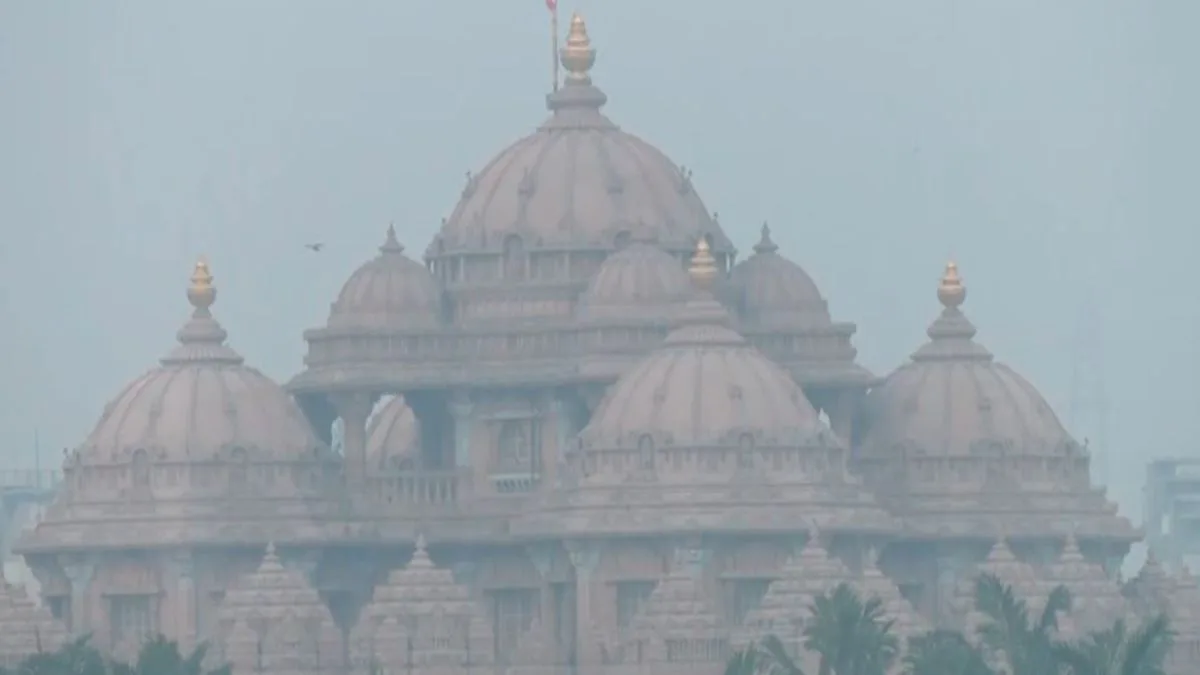
Delhi’s air quality improved sharply on Friday, dropping by more than 150 points, even as trace rainfall was witnessed in isolated areas of the city, experts said.
Trace rainfall was recorded at Lodhi Road and Ayanagar stations in Delhi during the 24 hours between 8:30 a.m. on Thursday and 8:30 a.m. on Friday, according to data from the India Meteorological Department (IMD).
Advertisement
Delhi’s 24-hour average air quality index (AQI), recorded by the Central Pollution Control Board (CPCB), improved sharply on Friday — dropping by more than 150 points from 373 on Thursday to 218, bringing it back to the ‘poor’ category. A day earlier, however, the city had seen a steep rise of nearly 100 points, with the AQI climbing from 279 on Wednesday to 373 on Thursday, according to CPCB’s national daily 4 pm bulletin.
Experts stated that due to precipitation in the neighboring NCR region and a trace amount of rainfall in parts of Delhi, the capital’s air has temporarily improved.
“However, the smog will gradually return as the wind speeds are feeble, and air quality is likely to deteriorate again in the coming days due to calm winds,” said Mahesh Palawat, Vice President, Skymet Weather Services.
According to the weather department, a fresh Western Disturbance is likely to influence the western Himalayan region from Monday night with a forecast of rainfall in the coming week.
Meanwhile, on Friday, the air quality in Ghaziabad (177), Noida (163), and Greater Noida (116) improved significantly, falling into the ‘moderate’ category. The sharp improvement followed Thursday’s rainfall, which brought a steep drop in AQI levels from 364, 372, and 330, respectively — all of which were in the ‘very poor’ range a day earlier.
As per CPCB classification, an AQI between 0 and 50 is ‘good’, 51 to 100 ‘satisfactory’, 101 to 200 ‘moderate’, 201 to 300 ‘poor’, 301 to 400 ‘very poor’, and 401 to 500 ‘severe’.