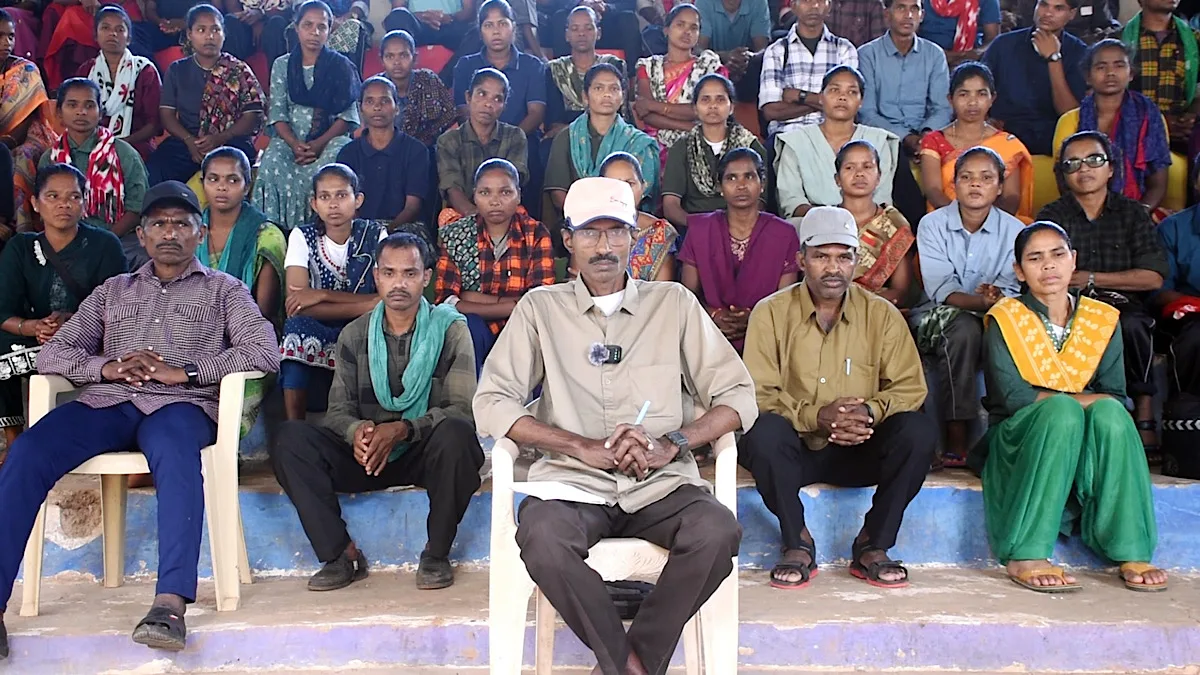
Barely six months before Union Home Minister Amit Shah’s March 31, 2026, deadline to wipe out the armed Left-Wing Extremism from Indian soil, the banned CPI (Maoist) appears to be battling deep internal divisions. The recent surrender of top Maoist leaders has exposed an ideological split within the organisation, marking one of the most serious internal crises in its five-decade-long insurgency across the Dandakaranya region.
Two major surrenders in Maharashtra and Chhattisgarh have shaken the Maoist hierarchy. In Maharashtra, Sonu, alias Venugopal, surrendered before Chief Minister Devendra Fadnavis on October 15, along with 60 cadres. Two days later, Rupesh, alias Satish, a central committee member of the CPI (Maoist), laid down arms in Jagdalpur, Chhattisgarh, along with 210 cadres and 50 weapons.
Advertisement
On Saturday, the Maoist Central Committee’s spokesperson, Abhay, issued a four-page pamphlet branding both leaders as “traitors”. He accused them of abandoning the revolutionary ideology under “right-wing influence” and choosing a life of comfort over struggle. “Those who leave the jungle for a life of luxury are no longer revolutionaries. It is a betrayal of the class struggle,” Abhay wrote.
However, in a series of video statements released before and after his surrender, Rupesh dismissed the allegations. “All paths had closed. The decision to suspend armed struggle was a collective one, taken by the Dandakaranya Special Zonal Committee,” he said.
“We have only set aside the armed struggle, not the people’s movement. We will now become the voice of the people through democratic means.”
Reacting to the “betrayal” charge, Rupesh asserted, “I am free and under no pressure. Fellow comrades are welcome to meet me and see for themselves that I have not betrayed the organisation.”
Security experts view the surrender of top Maoist leaders as a strategic success for the government’s counter-insurgency efforts. A senior police officer posted in South Bastar, speaking on condition of anonymity, said, “The surrender of high-ranking Maoist leaders like Rupesh and Sonu indicates that the Maoist organisation is weakening both ideologically and in terms of manpower. Their morale and organisational strength have eroded significantly.”
He added that improved rehabilitation policies and a strong intelligence network have accelerated the pace of surrenders, particularly in the Bastar and Gadchiroli regions, once regarded as the Maoist heartland.
Observers of Left-Wing Extremism believe these developments expose a deep ideological fracture within the Maoist movement. Veteran journalist and Maoist affairs expert Rajat Vajpayee said, “The Maoist organisation once thrived on its unity and ideological conviction, but that conviction is now crumbling. This is not just a military setback, it’s an ideological defeat.”
He further noted that the younger cadre is increasingly prioritising development and a dignified livelihood over armed struggle. “The new generation sees education and employment as the true path of struggle. Government rehabilitation and livelihood programmes have played a crucial role in this transformation,” Vajpayee added.
While surrendered Maoist leader Rupesh speaks of a “democratic struggle,” Maoist spokesperson Abhay maintains that the “class war” and “people’s war” will continue. “Revolution does not end with surrender. The struggle will persist as long as classes exist,” Abhay declared, urging cadres not to lose heart over “temporary setbacks.”
As internal dissent becomes more visible, many believe the Maoist movement is facing its most profound existential crisis. In the words of journalist Rajat Vajpayee, “The Maoists’ guns may not have fallen completely silent yet, but the sound of disagreement within their ranks is now far louder.”