Development is a process of growth in the direction of modernity especially towards nation-building and socio-economic progress. Development is referred to as a process of continuous progress, unyoking the people from the stages of dependency towards self reliance, assuring equitable distribution of opportunities and resources, and ensuring socio-economic justice and harmony among all sections of the society. Rural Development is a process of developing and utilizing natural and human resources, technologies, infrastructural facilities institutions and organisations, and government policies and programmes to encourage and speed up economic growth in rural areas, to provide jobs and to improve the quality of rural life.
Although in rural development programmes, priority should be given to the marginalized, poor and deprived section of society, they encompass all aspects of rural life, including nature and its elements, i.e. development of agriculture and allied sectors, socio-economic and political development, improving quality of rural life and rural disaster risk mitigation. The objectives of rural development, according to the World Bank, are not restricted to any single department but spread over several, and the resultant mix serves to raise agricultural output, create new employment, improve health and education, expand communications, provide housing, etc.
Advertisement
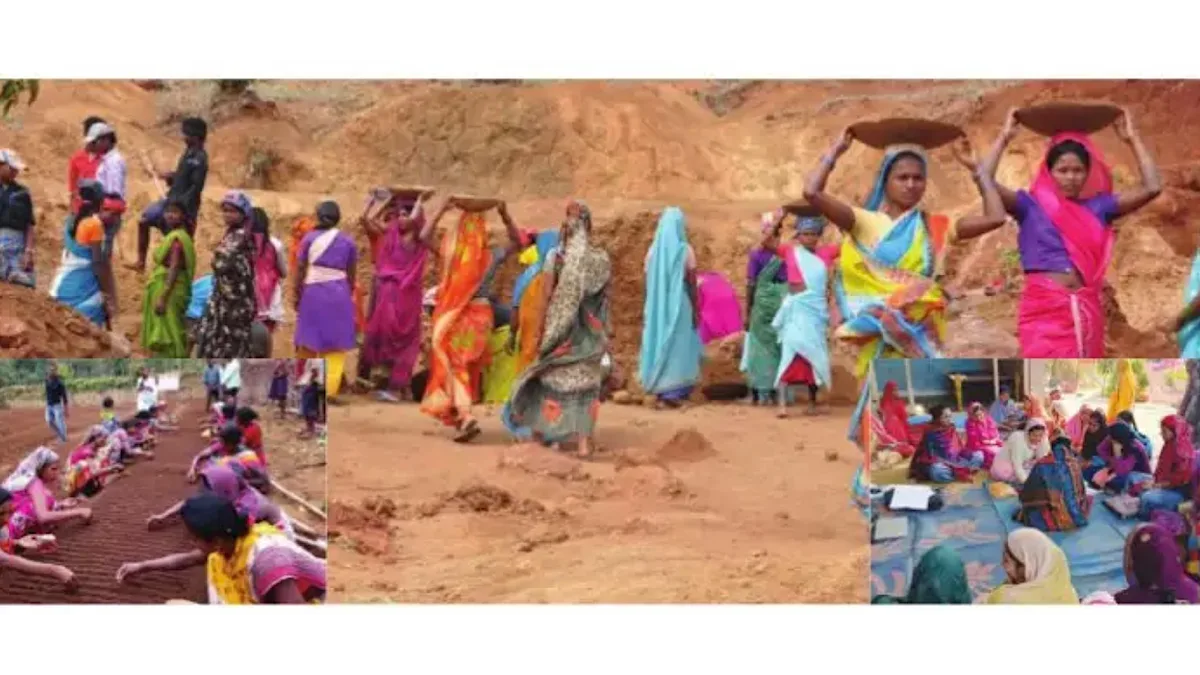
Women’s participation in rural development is crucial for social, economic, and environmental progress, as they are central to agriculture, household management, and community cohesion. Their involvement ensures that development initiatives address key issues like education and healthcare, promote gender equality, and lead to more sustainable and inclusive growth. Empowering women through access to resources, education, and decision-making roles is vital, as it directly contributes to improved livelihoods and community well-being. India has been a welfare state since Independence and government policies and programmes were designed to alleviate rural poverty.
It was realized that a sustainable strategy of poverty alleviation had to be based on increasing productive employment opportunities for the rural poor and providing a better and higher quality of life. Rural development is defined as the process of sustained growth of the rural economy and improvement of well-being of the rural population. The community development programme inaugurated on 2 October 1952, was an important landmark in the history of rural development. This was renamed as the Ministry of Rural Development on 23 January 1982. As per the 2001 Census, the total Indian population was 1027.01 million of which women accounted for 495.73 million. They constituted about 48.27 per cent of the population, performed two thirds of the work, and earned one third the remuneration. Rural women in India constitute 77 per cent of the female population.
They take abundant responsibilities and perform a wide spectrum of duties apart from household activities. Their significant contribution to the family makes them think critically about their poverty problems and the ways to overcome them. The participation of women in rural development is essential for building a strong economy and society. Women are vital for the sustainable development of rural areas, bringing added value to local communities. They are frequently the driving force behind innovation, diversification, and the development of new opportunities. In short, women give life to rural areas. When rural women are empowered, entire communities benefit.
Self-help is an ideology which aims at promoting self-reliant, self-manageable and sustainable institutions of the poor and the marginalized. Self-help promotion is a process. Self-help groups are structures which enable people’s participation to achieve self-management, self-reliance and sustainability. SHG is a vibrant, democratic and viable entity at grassroots level, which involves the people in planning, implementing and monitoring their development activities, and by mobilizing resources with its own strength. It encompasses economic, social, cultural, political aspects and is characterized by self-management. Economic activity such as savings and credit is one major activity that SHG undertakes, which has the potential to grow and bind the people together.
If SHGs, being small groups, are not found to be having sufficient bargaining strength or scale economies, they can be federated at village or mandal or block or taluk level. Such apex bodies would also add to their collective strength or contribute to scale economies. The Integrated Rural Development Programme (IRDP) was launched in 1978-79 in India. Through the SHG approach the poor rural women are prepared to build self-confidence through community action. Interactions in group meetings and collective decision-making enable them to identify and prioritize their needs and resources.
Swarna Jayanti Gram Swarojgar Yojana (1999), the most important programme for self-employment for the rural areas of the country was introduced by Central and State Governments. Like other centrally-sponsored programmes, it is implemented in the districts by the District Rural Development Cells (DRDC) of the Zilla Parishad. The main emphasis of the programme was to organize the poor in Self Help Groups (SHGs) and to augment their capacities for taking up economic activities for generation of income. Financial assistance in the form of bank credit and subsidy is provided for taking up economic enterprises. SGSY was restructured in 2010-11 for its implementation as the National Rural Livelihoods Mission (NRLM) or Deen Dayal Antyodaya Yojana-national Rural Livelihood Mission (DAY-NALM). Out of an estimated 25 million households organized into SHGs until 2010, only 22 per cent succeeded in accessing bank credit.
Studies showed that there were significant variations in the extent of mobilization of the poor through the formation of SHGs and the quality of their operation. Further, the SGSY programme focusing on single livelihood activity did not meet multiple livelihood requirements of the poor. The government restructured SGSY into National Rural Livelihoods Mission (NRLM) in FY 2010-11 to provide a sharper and greater focus as well as momentum for poverty reduction. India has around 1.2 core SHGs, 88 per cent being all-women SHGs. Success stories include Kudumbashree in Kerala, Jeevika in Bihar, Mahila Arthik Vikas Mahila Mandal in Maharashtra, and recently, Looms of Ladakh.
The SHG Bank Linkage Project (SHG-BLP), launched in 1992, has blossomed into the world’s largest microfinance project. With the active collaboration of stakeholders, the SHG-BLP covers 14.2 crore families through 119 lakh SHGs with savings deposits of Rs 47,240.5 core and 67 lakh groups with collateral-free loans outstanding of Rs 1,51,051.3 crore, as on 31 March 2020. Data from the Economic Survey 2022-2023 indicates that more than 140 million families are covered by SHG-BPL, with savings deposits totaling to Rs. 47.25 crores. Nearly 4 lakh Self Help Group members have been trained as Community Resource Persons (CRPs) who help in the implementation of the Mission at the ground level. The Mission has mobilized a total of 8.7 crore women from poor and vulnerable communities into 81 lakh SHGs. Recent date shows the massive scale of women’s participation in rural development through SHGs in India, with over 8.5 million SHGs and significant financial activity.
As of March 2022, about 1.2 crore SHGs existed, with 88 per cent being all-women groups, and the SHG-BLP (SHG Bank Linkage Project) covered 14.2 crore families, holding substantial savings and loans. More recently, as of July 2025, the cumulative credit disbursed to women’s SHGs reached Rs. 11 lakh crore, backed by a high repayment rate of over 98 per cent. Self Help Groups are considered as one of the most significant tools to adopt a participatory approach and have become economic change agents all over India, particularly in economically underdeveloped areas. They are improving the lives of women on various social and economic yardsticks. These groups are fantastic catalysts of rural development and fulfill two most important roles ~ poverty alleviation and women empowerment.
Nearly nine million SHGs with almost 100 million women as members have been working every day for the upliftment of rural livelihood in India. Now, nearly 14 SHGs are there in every Indian village and every 8th Indian woman, as a member of an SHG, has shown astonishing efforts for a silent revolution towards the achievement of the goal of Viksit Bharat.
The writer is Associate Professor, Department of Political Science, Chapra Bangaljhi Mahavidyalaya