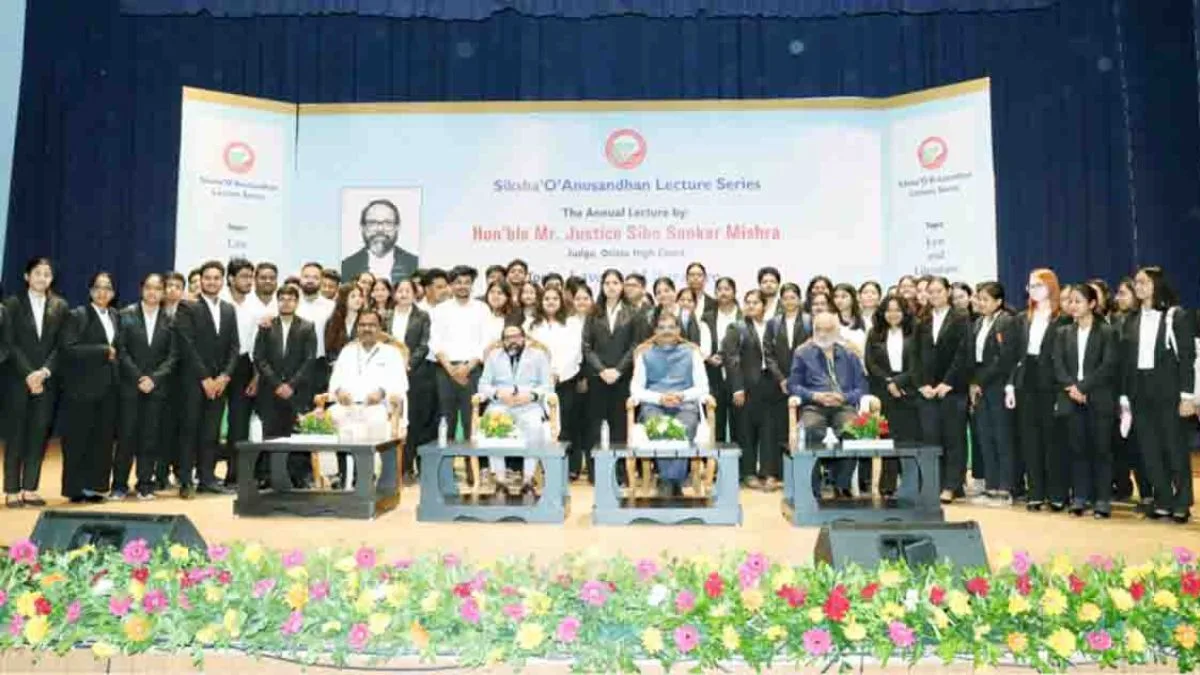
Law and literature are two distinct and different disciplines, but there is an inseparable linkage between the two, Justice Sibo Sankar Mishra of the Orissa High Court said on Saturday.
“Law is an instrument that regulates human conduct and behaviour, while literature provides expression to human behaviour, which in turn reflects the principles of law,” Justice Mishra said while speaking to students and faculty members of Siksha ‘O’ Anusandhan Deemed to be University here.
Advertisement
Justice Mishra was addressing the gathering as part of the SOA Lecture Series.
Pointing out that literature is often represented through writings, storytelling, painting, and theatre, he said that law can be found in literature and vice versa.
Citing the example of eminent novelist Fakir Mohan Senapati’s magnum opus, ‘Chha Mana Athaguntha’, Justice Mishra said the writer had exposed before society how the colonial land laws were being misused during that time.
“Law was represented through Senapati’s story,” he said.
Justice Mishra also referred to novelist Pratibha Ray’s famous work ‘Yajnaseni’, saying the renowned writer highlighted how women were suppressed in society under the yoke of patriarchal laws.
Shakespeare’s ‘Merchants of Venice’ also spoke about injustice and prejudices in society, while the mythology ‘Mahabharat’ explained the battle between ‘dharma’ and ‘adharma’, he said.
Prof Pradipta Kumar Nanda, Vice-Chancellor of SOA, presided over the programme while Prof Prabir Patnaik, Senior Professor in the SOA National Institute of Law (SNIL), introduced the speaker. Prof Jyoti Ranjan Das, Dean (Students’ Welfare), conducted the programme.
Referring to the ‘Ramayana’, Justice Mishra said the kidnapping of Sita reflected the illegal behaviour of the perpetrator. He was asked to return her, but he refused and was ultimately punished through execution.
Justice Mishra also cited the example of a series of old Hindi movies, including ‘Shree 420’, ‘Awara’, and ‘Kanoon’, saying the law was sought to be taught to society through cinematic representation through these films.
Recalling the story of the famous film ‘Andha Kanoon’, he said, the movie made it clear that no person could be punished twice for the same offence. Similarly, the nuances and technicalities of law were the focus of the film ‘No One Killed Jessica’, he added.
The famous dialogue ‘tarikh pe tarikh’ in the Hindi film ‘Damini’ was a reflection of the legal system pointing to delayed justice, Justice Mishra said.