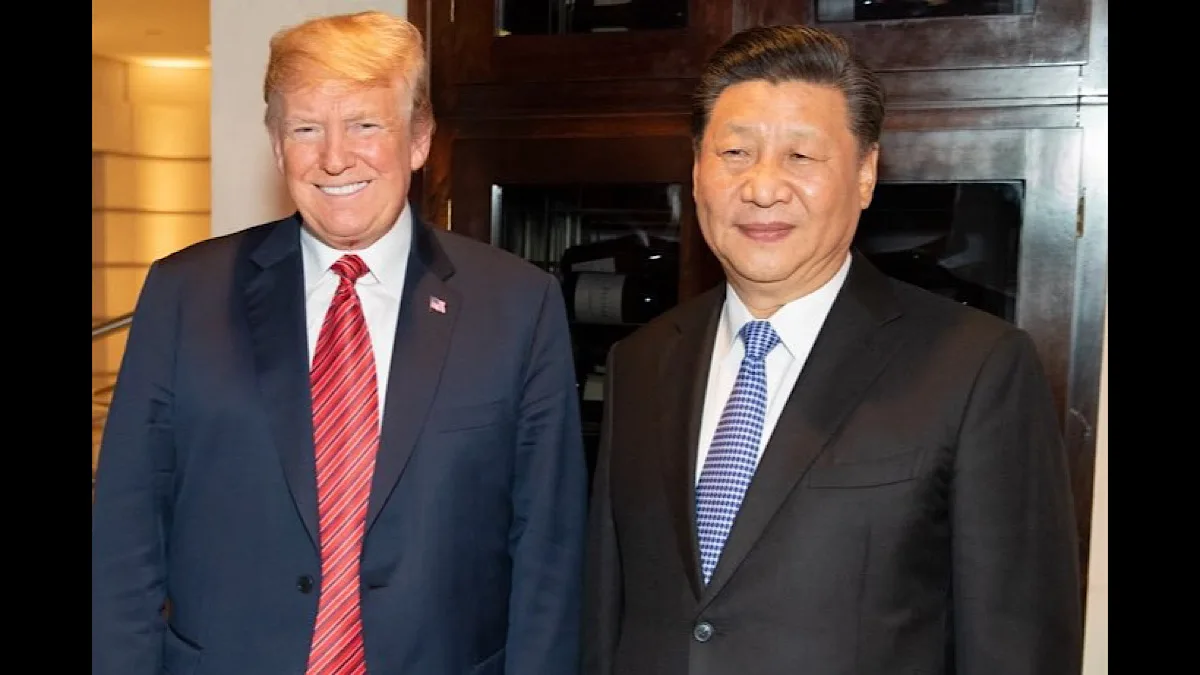
The upcoming meeting between US President Donald Trump and Chinese President Xi Jinping in South Korea coming Thursday is more than a bilateral tete-a-tete—it is a defining moment in the shifting geopolitical landscape of Asia, with profound implications for India’s strategic calculus.
Set against South Korea’s geopolitical fault lines, the meeting will address critical issues ranging from trade tensions and technology rivalry to security concerns around the Korean Peninsula and the Indo-Pacific. For India, situated at the nexus of these global currents, the outcome of this high-profile encounter will resonate far beyond diplomatic formalities.
Advertisement
First, the Trump-Xi dialogue signals a potential recalibration of US-China relations, which have oscillated between cooperation and confrontation. Any easing of tensions could alter the strategic balance in Asia, impacting India’s own engagements with these two superpowers. Conversely, a hardened stance may accelerate regional rivalry, compelling India to navigate an increasingly complex security environment.
Second, the summit coincides with heightened friction between the US and Russia, notably following sanctions on Russian oil giants and President Vladimir Putin’s stern warnings. India’s longstanding energy ties with Russia place it in a delicate position. The US has already responded to India’s Russian oil imports by imposing punitive tariffs, complicating New Delhi’s endeavors to secure a favorable trade arrangement with Washington.
Against this backdrop, Prime Minister Narendra Modi’s virtual participation in the ASEAN summit—eschewing an in-person meeting with President Trump—reflects India’s nuanced diplomacy. India is signaling its intent to preserve strategic autonomy while engaging selectively with major powers. This posture underscores India’s prioritization of energy security and economic growth over transactional alignments.
For India, the Trump–Xi meeting represents both a challenge and an opportunity. It calls for a proactive and adaptive strategy to leverage the evolving power dynamics—by accelerating the diversification of energy sources, strengthening partnerships with regional allies, and reinforcing its role in Indo-Pacific multilateral frameworks.
India’s ability to balance competing interests—between a rising China, a globally assertive US, and a resilient Russia—will determine its influence and security in the years ahead.
Ultimately, as Trump and Xi convene in Seoul, India stands at a strategic crossroads. The summit’s outcomes will ripple across Asia, testing New Delhi’s diplomatic agility and its vision for a stable, multipolar regional order. India’s future in this evolving chessboard depends on its skill to harness these dynamics to its advantage while safeguarding its sovereignty and growth trajectory.