Rajnath, Gadkari, Yogi inaugurate Lucknow-Kanpur Expressway
Defence Minister Rajnath Singh and Union Minister for Road Transport and Highways Nitin Gadkari inaugurated the Lucknow-Kanpur Expressway in Unnao on Monday.
Singh emphasised that the traditional defence outlook is no longer sufficient in today’s times as wars are fought not only on the borders, but have now taken a hybrid and asymmetrical form.




File Photo
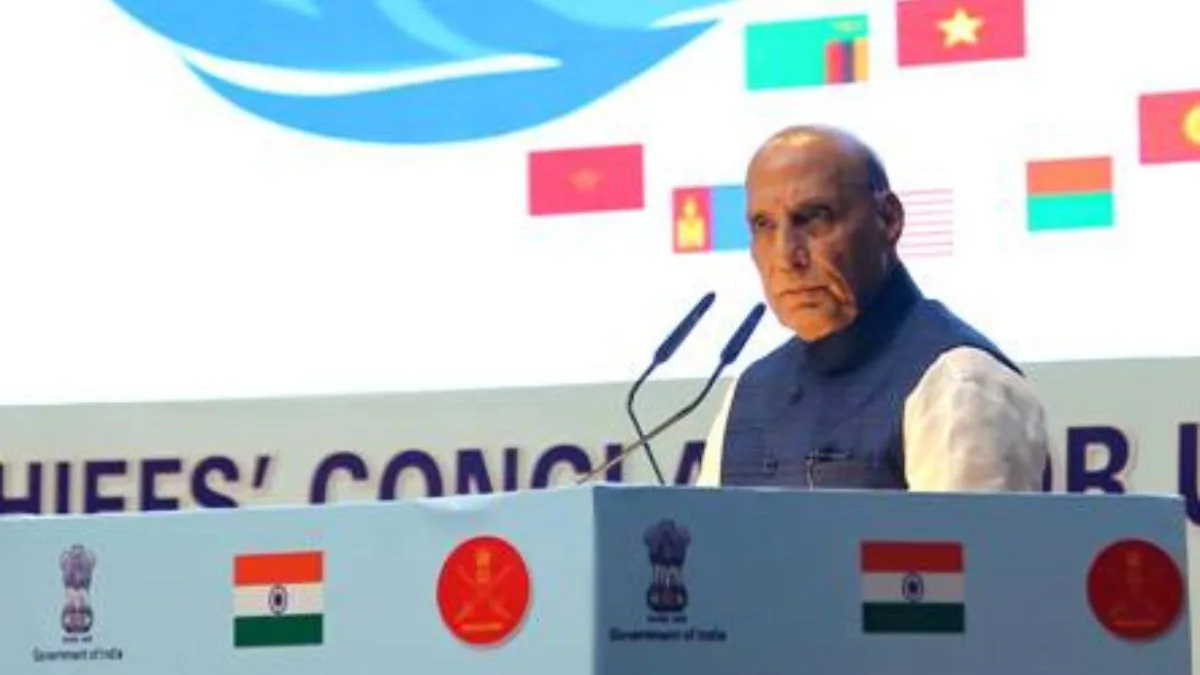
Defence Minister Rajnath Singh Wednesday said that Operation Sindoor witnessed exemplary jointness and integration among the tri-services, adding the government has taken bold decisions to build future-ready Armed Forces.
“Operation Sindoor witnessed extraordinary jointness and integration among the three Services, and reaffirmed the government’s resolve to devise coordinated, adaptive and preemptive defence strategies to deal with the challenges arising from the changing world order and evolving methods of warfare,” he said at a book launch function.
Advertisement
Singh emphasised that the traditional defence outlook is no longer sufficient in today’s times as wars are fought not only on the borders, but have now taken a hybrid and asymmetrical form.
Advertisement
The defence minister asserted that the Modi Government has undertaken several bold and decisive reforms to build future-ready Armed Forces to ensure national security as well as strategic autonomy of the country.
“One of the historic steps was the creation of the post of Chief of Defence Staff, which proved to be an important milestone in strengthening coordination and synergy among the three Services. The entire world witnessed the result of jointness and integration during Operation Sindoor. Pakistan is still recuperating from the severe blow dealt by our Armed Forces.”
The book ‘Civil-Military Fusion as a Metric of National Power & Comprehensive Security’, launched by Raksha Mantri, has been written by Lt Gen Raj Shukla (Retd).
Singh said the world today is moving beyond ‘division of labour’ and toward ‘integration of purpose’, and despite shouldering different responsibilities, there is a need to work with a shared vision. “Our civil administration and military are certainly separate in terms of division of labour, but since coming to power, our Prime Minister has emphasised that no administration can operate in silos; it must work in collaboration with each other,” he said.
Stressing the need to understand the nature of civil-military fusion in the present technology-driven era, he called for identifying core challenges and adopting a focused approach to effectively utilise civilian technological capabilities in the military domain while keeping international conventions in mind.
“In today’s global perspective, civil and military domains are gradually merging. Technology, economy, and national security are now interlinked more than ever before. Information, supply chains, trade, rare minerals, and cutting-edge technology etc. are being used in both domains. In such circumstances, civil-military fusion has become not a modern trend, but the need of the hour. Ignoring it is not good for strategic growth. Many of our important technologies often remain limited to civilian use. Under a dual-use concept, if these innovations are brought to military applications or vice versa, our national power can increase manifold,” he said.
Highlighting the concrete steps taken by the government towards civil-military fusion, the defence minister said the Armed Forces, Government, industry, start-ups, research institutes, and young innovators are today working together to achieve the goal.
He added that India’s defence ecosystem has witnessed a historic transformation in the last few
years, and the nation, which was once among the world’s largest defence importers, is rapidly emerging as a manufacturing hub. “Due to our consistent efforts, India’s defence sector is reaching unprecedented heights. Domestic production, which was around Rs 46,000 crore a decade ago, has now increased to a record Rs 1.51 lakh crore. Of this, approximately Rs 33,000 crore has been contributed by the private sector.”
Advertisement