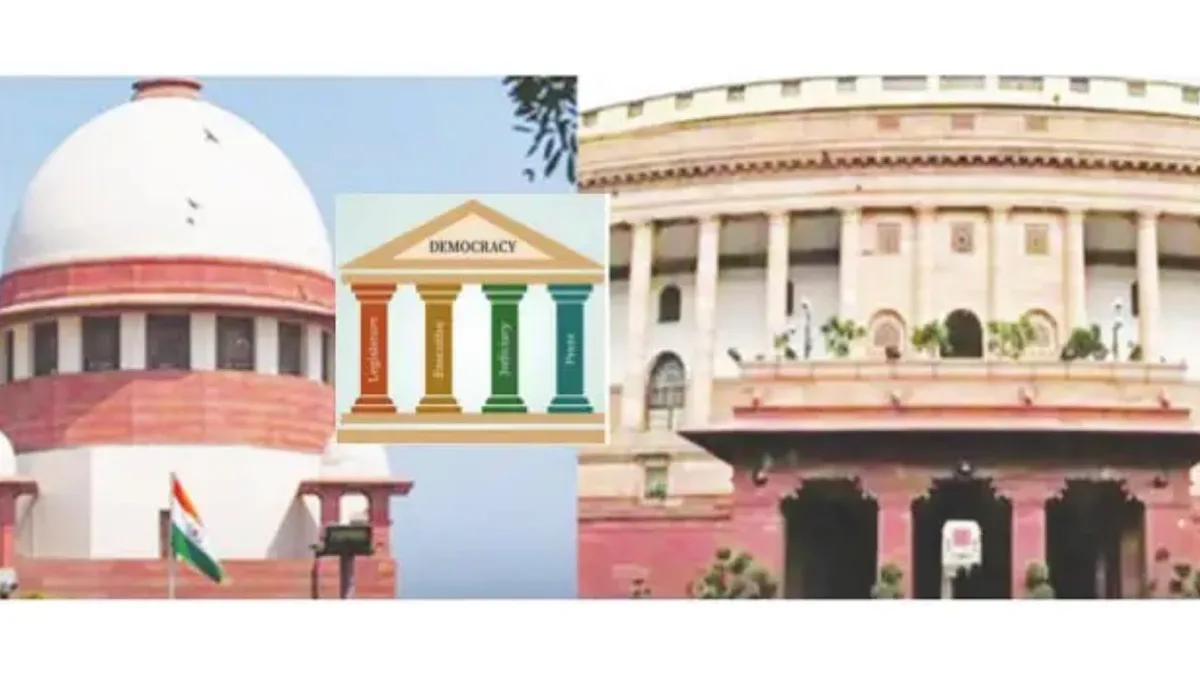
Democracy rests on four essential pillars ~ the executive, the legislature, the judiciary, and the media. While the first three are required to operate within structured constitutional frameworks, the fourth pillar is expected to function independently, as the voice of the people and the conscience of the nation. Its role is not merely to inform, but to question, analyze, and hold power accountable.
Yet today, we must ask: has the media remained true to this noble responsibility, or has it gradually shifted from amplifying public concerns to echoing the interests of influence and profit? In the age of digital connectivity, media has evolved from newspapers and radio to television and social platforms. This transformation has empowered millions ~ especially the youth and semi-literate masses ~ with instant access to information. Mobile phones have become the new window to the world, even in remote corners of India.
Advertisement
However, this reach comes with responsibility. Visual media, especially television and social platforms, possess unmatched power to shape perceptions. Their repetitive rhetoric and emotionally charged visuals often influence public opinion more than facts. In contrast, print media ~ though more restrained and analytical ~ reaches a limited, educated audience capable of forming independent judgments. It is important to acknowledge that print media operates under constraints: limited reach, economic pressures, and a shrinking space for dissent. Yet it continues to serve as a vital platform for thoughtful discourse. The real concern lies in the disproportionate influence of electronic media, which often prioritizes sensation over substance.
Television debates, once meant to foster dialogue, have become theatrical performances. Party spokespersons and celebrity panellists dominate screens, while grassroots voices and independent experts are sidelined. Rational discourse is replaced by aggressive rhetoric, leaving citizens with fragmented perspectives. The coverage of sensitive operations, such as the much-hyped “Operation Sindoor,” often veers into the realm of oration and unverified claims, ultimately eroding credibility. The absence of fact-based, sober analysis in such moments is not just a lapse ~ it is also against national interest.
Even print journalism, once revered for its investigative depth, faces increasing pressure to conform. Editorial spaces shrink, dissenting voices fade, and content often aligns with corporate or governmental interests. The vigorous follow-up that once defined journalism is now a rarity. A disturbing trend in contemporary media is the absence of serious, constructive debate on issues that truly matter. Consider the crumbling infrastructure ~ collapsing bridges, potholed roads, and civic neglect that rarely receive sustained coverage or accountability.
Public health crises such as hazardous adulteration in food and medicines, unaffordable healthcare, and sanitation issues remain underreported. The lack of a unified, skill-oriented education policy has led to a generation of “unemployable” angry and frustrated youth ~ yet this crisis finds little space in prime-time discussions. Over four lakh undertrials languish in jails without trial ~ an alarming human rights issue that barely surfaces in mainstream media. The politicisation of bureaucracy, civil administration, and law enforcement undermines public trust, but rarely invites scrutiny. Road rage, traffic violations, and growing indiscipline among youth – including the well-educated – are treated as isolated incidents rather than systemic concerns.
Instead of addressing these pressing issues, media often gravitates toward celebrity gossip, political theatrics, and polarising narratives that serve vested interests. The doling out of freebies from public funds, often aimed at securing vote banks, rarely faces rigorous scrutiny. While welfare schemes are essential in a developing nation, the absence of transparent debate on their long-term impact and fiscal sustainability is troubling. The taxpayer, whose contribution fuels these schemes, seldom finds representation in televised discussions. Instead, the narrative is shaped by political convenience, not economic prudence. This silence on financial accountability is a disservice to the nation’s developmental aspirations.
Artificial Intelligence has added a new layer of complexity. Deep fakes, manipulated videos, and algorithm-driven content now shape public perception. Bots amplify outrage, anonymous accounts spread propaganda, and engagement often trumps accuracy. This manipulation doesn’t just mislead ~ it reshapes history, distorts governance, and makes citizens vulnerable to tailored narratives. Without vigilant fact-checking and independent journalism, media risks becoming an instrument of deception. What was once considered mere bias has evolved into active distortion, where media can manufacture reality. The line between truth and propaganda is increasingly blurred, and in such an environment, the integrity of journalism faces its greatest challenge -upholding truth over profitability. In this landscape, the voices of ordinary citizens ~ those without political clout, celebrity status, or bureaucratic power ~ are often ignored.
The media’s reluctance to challenge political failures or amplify grassroots concerns creates a widening gap between governance and the governed. Citizens struggling with unemployment, poor civic services, pollution, and delayed justice find little representation. Instead of being platforms for activism and reform, media institutions increasingly cater to elitism. The public, regardless of intellect or reasoning, often finds itself unheard ~ simply because it does not fit a predetermined mould: a politician backed by a vote bank, a bureaucrat with influence, a celebrity, or a figure of fear or authority. This exclusion is not just unfortunate, it is dangerous. The absence of a common, workable national education policy is another silent crisis.
Without a unified framework that prioritizes skill development and employability, we risk alienating an entire generation from meaningful participation in the economy. Media, instead of spotlighting this urgent need, often remains preoccupied with political drama. The youth, who should be the architects of Viksit Bharat, are left without guidance, inspiration, or platforms for constructive engagement. Their frustration manifests in indiscipline, apathy, and misplaced aggression, symptoms of a deeper systemic neglect. Finally, the media must also hold the Opposition to account ~ not merely for its criticism, but for its absence of a clear developmental roadmap.
In a vibrant democracy, a constructive Opposition is not a luxury but a necessity. It must rise above personal attacks and partisan theatrics to offer meaningful support where due, challenge where needed, and inspire confidence through ideas that serve the nation. India deserves leaders who do not just oppose, but propose ~ who transform dissent into direction and prove themselves as indispensable partners in governance. The challenges that we face today are real and demand action without delay. In the wake of global tariff wars and the urgent need for economic self-reliance, we must awaken a sense of national responsibility ~ especially among our youth.
This requires introspection, skill development, and a responsive infrastructure. Our political leadership, bureaucracy, and administrative machinery must rise to the occasion and that too without any delay. The media equally, must play a central role in this transformation. It must prioritize truth over influence, integrity over revenue, and citizen welfare over corporate sponsorships.
It must return to fearless journalism, seek accountability, and restore its place as democracy’s unwavering guardian and its strong Fourth Pillar. As Hélder Câmara warned, “The freedom of journalists is now becoming, in most cases, a very relative thing: it ends where the interests of the business begin.” And what Akbar Allahabadi had once reminded us, when electronic media was just taking roots, is still relevant “Kheencho na kamano ko, na talwar nikalo; jab top mukabhil ho, akhbaar nikalo” (Draw not your bow, nor unsheathe the sword; when guns cannot counter, publish a newspaper). Let us not forget the power of the Fourth Estate ~ not just to inform, but to transform.
(The writer is a retired Air Commodore, VSM, of the Indian Air Force)