Taking an indirect jibe at Pakistan and the United States, Defence Minister Rajnath Singh on Tuesday said few nations are openly violating the international rules, while others are trying to undermine it, or create their own rules and dominate the next century.
“In all this, India while advocating for the reformation of outdated international structures, stands strong in upholding the international rules-based order,” he said.
Advertisement
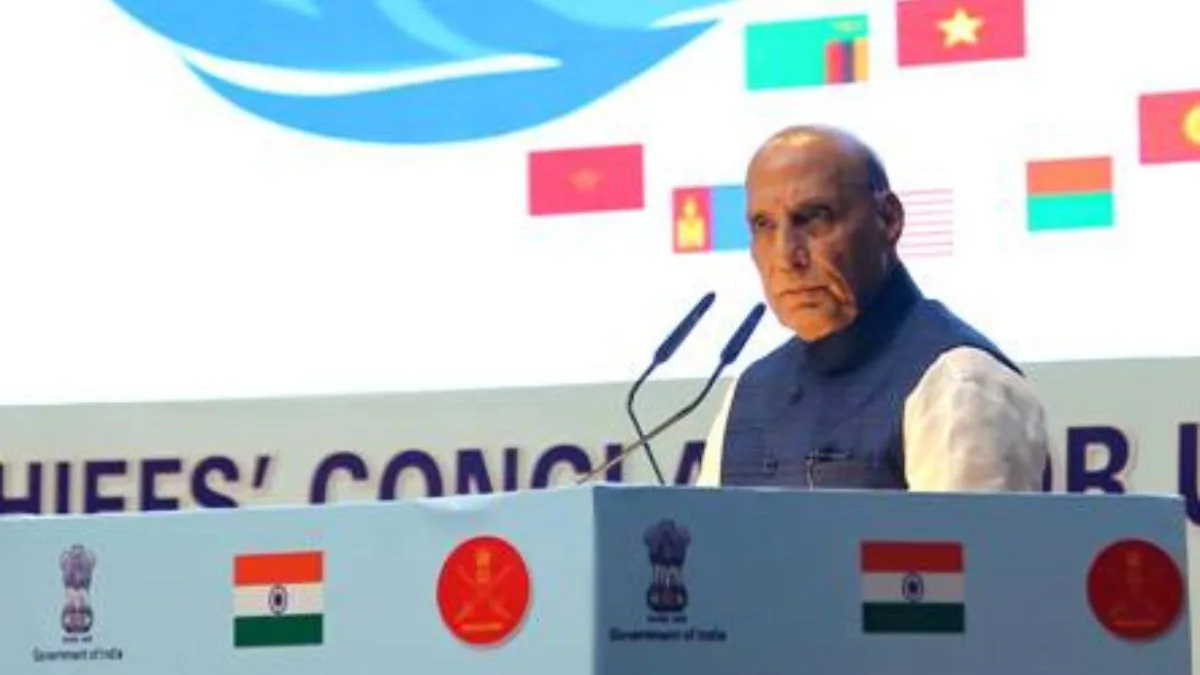
Singh was addressing the senior military leadership of United Nations Troop Contributing Countries (UNTCC) during the inaugural session of the Chiefs’ Conclave, being hosted by India for the first time, at Manekshaw Centre here.
Calling for the need to have upgraded technology, he said today’s challenges cannot be fought with outdated multilateral structures.
“Meeting the emerging challenges demands more than bravery, adaptability, innovation on part of the troop contributing countries, and a comprehensive mission level approach taking on board relevant political actors, finance contributing countries, and other key players influencing the conflict environment to achieve the mandate.
“These operations often fall short due to delayed deployment, inadequate resources, and an insufficient mandate to address the root causes of conflicts. We cannot fight today’s challenges with outdated multilateral structures. Without comprehensive reforms, the UN faces a crisis of confidence.
“For today’s interconnected world, we need a reformed multilateralism that reflects realities; Gives voice to all stakeholders; Addresses contemporary challenges; and focuses on human welfare,” asserted Singh.
Stating that for India, peacekeeping has never been an act of choice but an article of faith, the defence minister said, “From the very dawn of our independence, India has stood firm with the United Nations in its mission to maintain international peace and security. For us this is not just a talking point, thousands of Indians serve for the cause of peace and development under the UN flag. This is a prominent example that reflects India’s principle of aligning promises with performance and the commitment to upholding international order.”
Highlighting that India has always stood firm with the UN in its mission to maintain international peace and security, and it remains steadfast in this commitment.
“Over the decades, nearly 2,90,000 Indian personnel have served in more than 50 UN peacekeeping missions, earning global respect for professionalism, courage, and compassion. From the Congo and Korea to South Sudan and Lebanon, our soldiers, police, and medical professionals have stood shoulder to shoulder with the international community to protect the vulnerable and rebuild societies.
“We are ready to contribute troops, share expertise, and support reforms that make peacekeeping more effective & accountable. Through cooperation and technology sharing, we can build missions that are better equipped, more adaptive & more humane,” he stated.
Singh further described the growing participation of women as one of the most inspiring transformations in peacekeeping, stating that their presence enhances the mission’s effectiveness, builds trust with local populations, and brings empathy into operations.
“India has been a pioneer in this domain. Our all-women Formed Police Unit deployed to Liberia in 2007 became a global symbol of empowerment. Their professionalism and compassion inspired a generation of Liberian women to join their national police. Today, Indian women officers serve in missions across South Sudan, Golan Heights and Lebanon, leading patrols, engaging with communities, and mentoring local women and youth. They represent the best of what modern peacekeeping can achieve — inclusion, respect, and trust.
In 2024, an Indian Army woman peacekeeper was awarded the United Nations Military Gender Advocate of the Year Award for her exemplary service with the UN peacekeeping mission in the Democratic Republic of Congo,” he added.
While concluding his speech, the defence minister propagated enhanced Consultation, Cooperation, Coordination & Capacity Building – a 4C formula – as a guiding principle for the countries contributing towards United Nations peacekeeping to tackle emerging challenges and ensure global peace.