It began like a whisper — a faint drizzle on tin rooftops, the sound of rain on the leaves, the quiet promise of a monsoon that had overstayed its welcome. By dawn, that whisper had turned into a roar. Hills crumbled, rivers rose, and the people of North Bengal once again stood face to face with the fury of nature. It was October 2025, but to the older generation, the date felt eerily familiar. The flood had come again – in the same week, the same month, as it had fifty-seven years ago, in October 1968, and again in 2023.
The Teesta had returned, carrying memories of every life it once took, and every warning we chose to forget. The first great flood that scarred Jalpaiguri’s memory began on 2 October 1968. It rained relentlessly for days – not just in Jalpaiguri, but also in Maynaguri, Domohani, and across the upper Teesta basin. On the night of 4 October, the river burst its banks without warning. In those days, Jalpaiguri was a small, quiet town of one-story houses and tin roofs. At around 2 a.m., water rushed in through the Karala River, and within minutes, the Te esta swallowed entire neighborhoods. Bridges broke, roads vanished, and homes were swept away like toys.
Advertisement
The official records spoke of numbers – 216 lives lost, 345 houses destroyed, 1,370 cattle drowned – but for those who survived, it was more than statistics. It was the night the Teesta changed from a lifeline to a curse. The bridge connecting Jalpaiguri to the Dooars was torn apart, cutting off the region for weeks. Even decades later, elders still speak of that night with a trembling voice – a memory soaked in fear and rain. Fast forward to 3 October 2023, when a distant glacier in North Sikkim’s South Lhonak Lake gave way, releasing millions of cubic meters of water, rock, and ice.
The resulting Glacial Lake Outburst Flood (GLOF) unleashed a torrent that tore through the Teesta basin. The river rose by nearly 60 feet, sweeping away everything in its path — bridges, homes, hydropower plants, and people. Over 142 lives were lost or went missing. The destruction of the Teesta III Hydropower Dam became a symbol of modern vulnerability – how our engineering pride can crumble in moments before the raw force of the mountains.
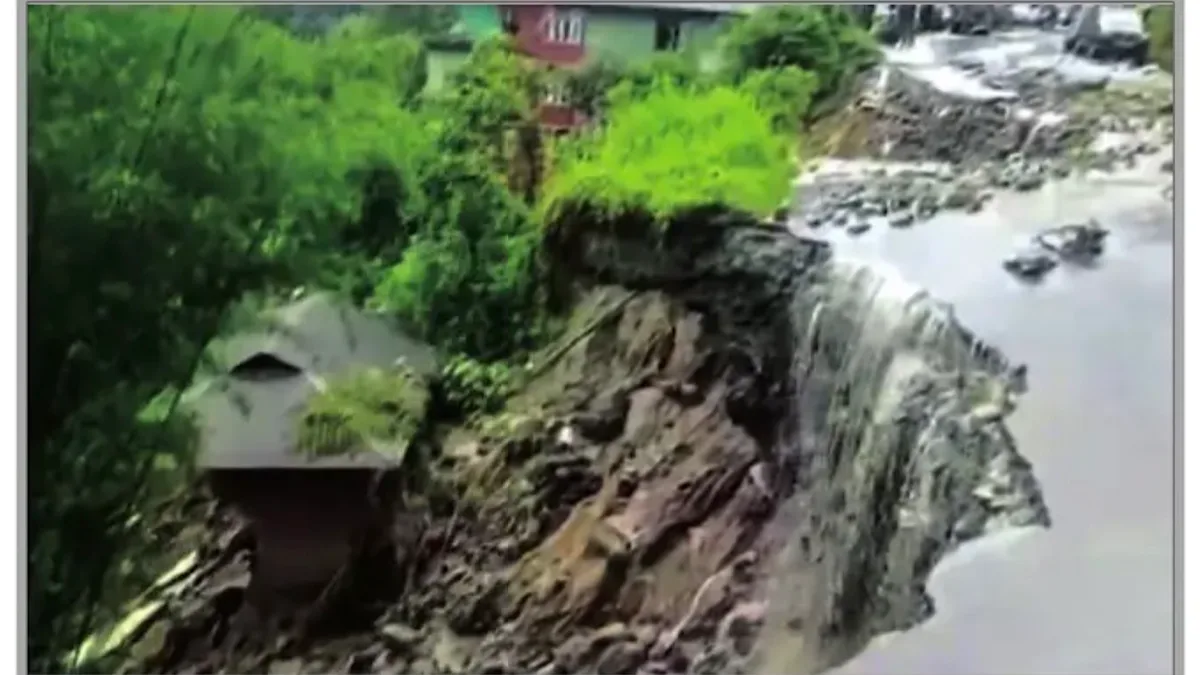
Experts said the disaster was triggered by a combination of glacial melting, excess rainfall, and unstable slopes – the price of a warming planet and unchecked construction in fragile Himalayan terrain. But beyond the science lay a deeper truth: nature had once again issued its warning. And, as always, we returned to normal life once the waters withdrew, our lessons half-learned. Then came October 2025 – the same month, the same fury. Heavy rains lashed Darjeeling, Jalpaiguri, and Cooch Behar, recording over 260 mm of rainfall in just 24 hours. Rivers like the Teesta, Torsa, and Jaldhaka swelled beyond danger levels. Forests flooded, animals drowned, and the fragile hills gave way under the burden of water. The scenic Mirik was the worst hit.
The iron bridge connecting Dudhia to Mirik collapsed, taking several lives with it. Landslides blocked roads across Darjeeling district – Rohini Road, Pulbazar, Bijanbari – cutting off entire communities. Tourists stranded in the Dooars and Kalimpong watched the hills crumble around them as the Teesta rose above the national highway, swallowing sections of NH-10 and silencing the hum of civilization. By the next morning, the toll had risen to 28 dead, hundreds injured, and countless missing.
Among the ruins, a man named Mohammad Allaudin in Mirik woke up to cries for help. Outside, the rain thrashed mercilessly. When he ran out, he found his landlord, his wife, and their child buried under a wall of mud and trees – three more names added to nature’s ledger of loss. Around him, the hills looked like open wounds – gashes of brown where green once thrived, rivers of mud where roads had been. Even the forests weren’t spared; carcasses of elephants and deer floated downstream, tangled in the same debris as human remains. The Teesta had blurred the lines between man and animal, rich and poor, past and present – reminding us that in nature’s court, all are equal.
These floods are not coincidences. They are patterns of neglect. The Himalayas, fragile and restless, are cracking under the weight of our ambition. We blast their sides for roads, dam their rivers for power, and build hotels on their veins. Every tree cut, every encroachment, every ignored environmental report pushes us closer to the next disaster. The Teesta, once worshipped as a goddess, now returns as an avenger – not out of malice, but out of balance. From 1968 to 2023 to 2025, it has repeated the same message in water, stone, and death: Respect me, or remember me. We call these events “natural disasters,” but there is nothing natural about them anymore. They are man-made wounds, reopened year after year by greed and apathy. The glacial lakes are swelling because we warmed the planet. The rivers rage because we choked their beds.
The hills crumble because we stripped them bare. And yet, after every flood, we return to building and forgetting – until the next October arrives to remind us what we buried. When the water finally receded this year, the air in North Bengal felt heavy — not just with moisture, but with grief. Villagers searched for missing family members, while forest guards pulled the bodies of animals from the rivers. Tourists clicked photos of landslides, then hurried home. And in the stillness that followed, the hills seemed to whisper the same question – one that has echoed since 1968: If nature is a teacher, then the Teesta is a patient one. For decades, she has tried to remind us that coexistence, not conquest, is the only path forward.
Yet, we remain defiant – building in flood zones, cutting forests, and dismissing every tragedy as fate. But fate is not what kills us. Forgetfulness is. The Teesta’s revenge is not vengeance – it is memory. Memory of what we’ve taken and what we’ve lost. The floods of 1968, 2023, and 2025 are not three separate disasters, but one long story written in water – a story of how humans forgot their place in nature’s design. Until we learn to remember, October will keep returning. And the Teesta will keep writing her warning, one flood at a time.
(The writer is former Professor of Political Science, Chanchal College, Malda.)