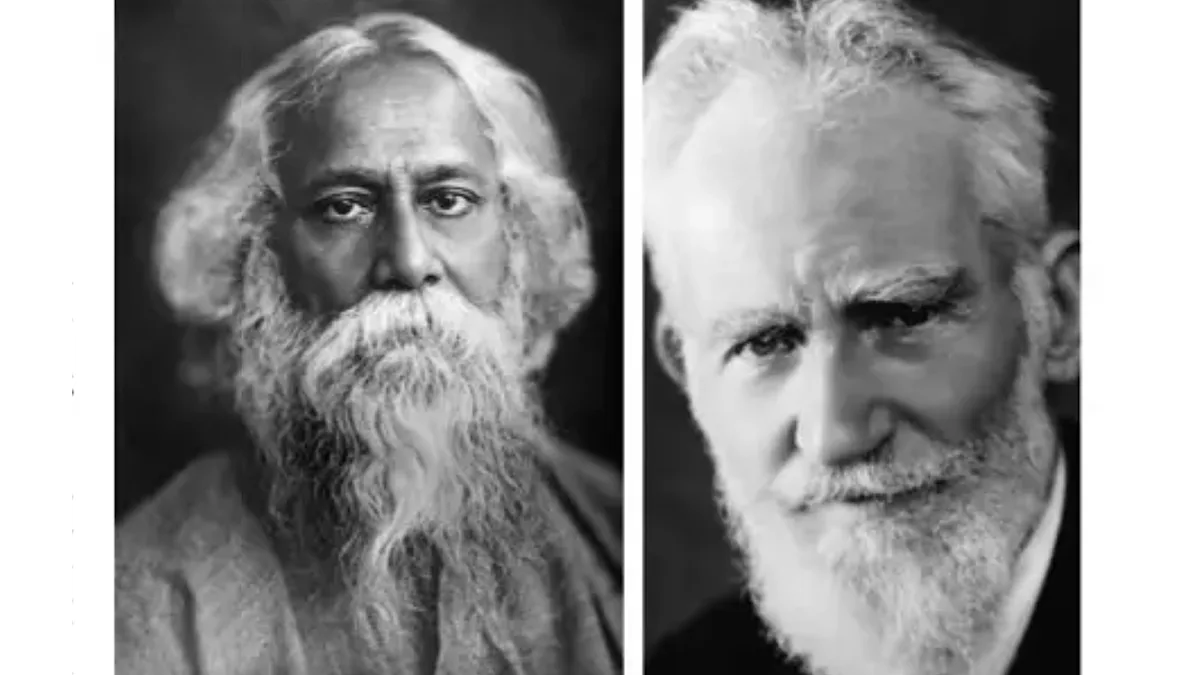
In the constellation of 20th intellectual giants, few figures shine as brilliantly or cast shadows as long as George Bernard Shaw and Rabindranath Tagore. These two Nobel laureates, separated by geography, culture, and temperament, emerged as prophetic voices for humanity at a time when the world stood at the crossroads of modernity and tradition, reason and faith, revolution and evolution. Their contrasting approaches to the human condition-Shaw’s razor-sharp rationalism and Tagore’s lyrical spiritualism-illuminate two fundamental paths toward truth that continue to resonate in our troubled age. Both men transcended the boundaries of literature to become moral philosophers for their times.
Shaw, the Irish playwright who conquered the London stage, wielded wit like a surgeon’s scalpel, dissecting the hypocrisies of capitalist society with surgical precision. Tagore, the Bengali polymath who gave voice to India’s cultural renaissance, painted his vision of human dignity across poetry, music, education, and philosophy with the broad strokes of a master artist. Yet for all their differences, both shared an unwavering faith in humanity’s capacity for transformation and an understanding that art must serve a purpose greater than mere entertainment. At the heart of both men’s work lay a profound conviction that art could not be divorced from moral responsibility.
Advertisement
Shaw famously declared that “all art should be didactic,” while Tagore believed that true art must express the deepest truths of human existence. Neither man subscribed to the doctrine of art for art’s sake; instead, they viewed their creative work as instruments of social and spiritual awakening. Their shared rejection of narrow dogmatism marked another point of convergence. Shaw, despite his socialist convictions, remained fiercely independent, attacking both capitalist exploitation and communist orthodoxy with equal fervor. Tagore, rooted in Indian philosophy yet cosmopolitan in outlook, criticized both Western materialism and Eastern fatalism. Both men understood that truth could not be confined within the boundaries of any single ideology or tradition.
Perhaps most significantly, both Shaw and Tagore possessed an almost mystical faith in human potential. Shaw’s concept of the “Life Force” driving evolutionary progress toward a race of supermen echoed Tagore’s belief in the divine spark within every human being. Though one grounded his optimism in biological evolution and the other in spiritual transformation, both refused to accept humanity’s current limitations as final. Yet it was in their fundamental approaches to human transformation that Shaw and Tagore most clearly diverged. Shaw, the supreme rationalist, believed that clear thinking and social reorganization could solve humanity’s problems.
His plays stripped away romantic illusions to reveal uncomfortable truths: that capitalism corrupted human relationships (Major Barbara), that war was the sport of the idle rich (Arms and the Man), that conventional morality often masked deeper immoralities (Mrs. Warren’s Profession). For Shaw, enlightenment came through the ruthless application of reason to social problems. Tagore, while no enemy of reason, located the source of human redemption in the realm of the spirit. His poetry sang of a universal love that transcended racial, religious, and national boundaries. Where Shaw wrote devastating satires, Tagore composed uplifting hymns. Where Shaw advocated for scientific socialism, Tagore promoted what he called “universal humanism” – a philosophy that saw all human beings as children of the same divine source.
Their attitudes toward science and mysticism further revealed this fundamental divide. Shaw embraced scientific materialism, seeing in Darwin’s theory of evolution the key to understanding human progress. He believed that humanity could consciously direct its own evolution through rational planning and social engineering. Tagore, while appreciating scientific achievement, warned against reducing human experience to mere material processes. He insisted that intuition and spiritual insight provided access to truths that science could never reach. This philosophical difference expressed itself in their literary styles as well. Shaw’s dialogue crackled with intellectual energy, his characters engaging in brilliant debates that illuminated social contradictions. His stage directions read like miniature essays, his prefaces like political manifestos.
Tagore’s language, even in translation, possessed a lyrical quality that spoke directly to the emotions and imagination. Where Shaw sought to convince through argument, Tagore aimed to transform through beauty. The personal encounters between these two titans provide fascinating glimpses into their contrasting sensibilities. When Shaw visited Tagore in London in 1930, the Bengali poet was struck by the Irishman’s relentless energy and penetrating intellect. “Shaw is like a sword,” Tagore observed, “always ready to cut through pretense and cant.” Shaw, in turn, admired Tagore’s serenity and depth, though he remained skeptical of what he saw as the poet’s mystical tendencies. “Tagore is a beautiful soul,” Shaw remarked to a friend, “but he would benefit from a dose of common sense.” Their correspondence reveals both mutual respect and fundamental disagreement.
Shaw sent Tagore copies of his plays, hoping to convert the poet to his brand of social realism. Tagore responded with volumes of his poetry and philosophical essays, gently suggesting that Shaw’s rationalism, however brilliant, captured only one dimension of human experience. “Dear Shaw,” Tagore wrote in one letter, “your plays make me think, but my soul remains hungry. Man cannot live by arguments alone.” The most illuminating exchange concerned their views on nationalism. Shaw, the internationalist socialist, saw nationalism as a dangerous delusion that divided the human family. Tagore, despite his criticism of narrow nationalism, believed that genuine love of one’s own culture and country could serve as a stepping stone to universal love.
“One cannot love humanity in the abstract,” Tagore argued, “any more than one can love music without hearing particular melodies.” Shaw remained unconvinced: “Patriotism is the last refuge of scoundrels, and the first excuse of fools.” Their different approaches to human development manifested most concretely in their educational philosophies. Shaw advocated for rational, scientific education that would produce clear-thinking citizens capable of building a socialist society. He believed schools should be laboratories for social experimentation, training grounds for future revolutionaries who would reshape society according to rational principles. Tagore’s experimental school at Santiniketan embodied a radically different vision.
There, education aimed not merely to impart knowledge but to cultivate the whole human being – intellectual, emotional, artistic, and spiritual. Students learned through direct contact with nature, participation in creative activities, and exposure to the cultural traditions of both East and West. Where Shaw sought to produce rational revolutionaries, Tagore aimed to nurture complete human beings capable of creating a harmonious world civilization. Today, as humanity grapples with climate change, technological disruption, rising inequality, and cultural fragmentation, the contrasting visions of Shaw and Tagore remain strikingly relevant.
The current debate between technocratic solutions and humanistic approaches to global problems essentially recapitulates their century-old disagreement. Shaw’s rational, systematic approach finds expression in contemporary movements for evidence-based policy, scientific management of social problems, and technological solutions to human challenges. His faith in human reason and social engineering echoes in the work of policy experts who believe that careful analysis and institutional reform can address issues from poverty to climate change.
Tagore’s emphasis on cultural synthesis, spiritual development, and universal humanism resonates with those who argue that humanity’s problems are fundamentally moral and spiritual rather than merely technical. His vision of education that nurtures the complete human being influences progressive pedagogical movements worldwide. His belief in the power of art and beauty to transform consciousness finds echo in therapeutic and community-building practices that emphasize creativity and human connection. Perhaps most importantly, both men’s rejection of narrow ideological thinking remains urgently relevant.
In an age of increasing polarization, their example of maintaining independent critical faculties while remaining committed to human welfare offers a model for constructive engagement across ideological divides. Ultimately, Shaw and Tagore may be better understood as complementary rather than contradictory figures. Shaw’s penetrating analysis of social structures and power relations provides essential tools for understanding and addressing systemic problems. His insistence on clear thinking and rational planning offers necessary correctives to wishful thinking and sentimental solutions. Tagore’s emphasis on spiritual development and cultural creativity addresses dimensions of human experience that purely rational approaches often neglect.
His vision of education that nurtures the whole person provides necessary balance to overly technical or narrowly vocational training. His faith in the transformative power of beauty and love offers hope in the face of seemingly intractable problems. The world today needs both Shaw’s analytical rigor and Tagore’s synthetic vision, both his skeptical intelligence and the poet’s affirming faith. Shaw’s question – “How shall we organize society rationally?” – requires Tagore’s complement – “How shall we live meaningfully?” Shaw’s focus on changing structures must be balanced with Tagore’s emphasis on transforming consciousness. The playwright’s concern with justice needs the poet’s commitment to beauty, just as Tagore’s universalism benefits from Shaw’s attention to specific social realities.
In their different ways, both men understood that the transformation of humanity could not be achieved through any single approach. Shaw’s rational sword and Tagore’s spiritual song, when wielded together, might yet help humanity find its way toward the more perfect world that both envisioned. Their legacy reminds us that the path to truth is wide enough for both the skeptic’s question and the mystic’s affirmation, both the reformer’s blueprint and the poet’s dream. As we face the challenges of our own age, perhaps we need not choose between these two prophets of humanity but rather learn to walk both paths simultaneously – thinking clearly while dreaming beautifully, analyzing ruthlessly while loving universally, reforming society while transforming ourselves. In such a synthesis, the enduring wisdom of both Shaw and Tagore might finally find its fullest expression.
(The writer is a retired civil servant.)