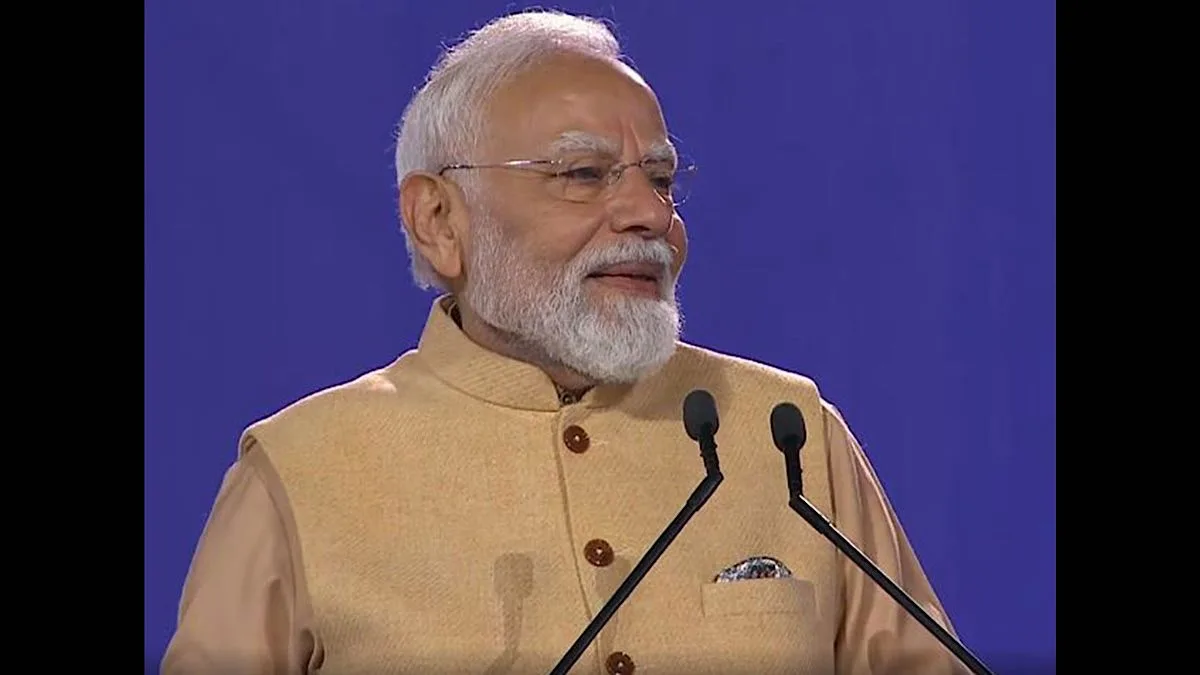
Prime Minister Narendra Modi on Sunday addressed the nation on next-generation Goods and Services Tax (GST) reforms, announcing a “GST Bachat Utsav” from Monday, September 22, when the revised GST rates take effect.
“From tomorrow in the nation, ‘GST Bachat Utsav’ will commence. Your savings will increase and you will be able to buy your favourite things…’GST Bachat Utsav’ will benefit all sections of the society…,” Modi said in his address.
Advertisement
Congratulating millions of families across the country for the Next Generation GST reforms and ‘GST Bachat Utsav’, Modi said that the next-generation GST reforms will accelerate India’s growth story.
“These reforms will accelerate India’s growth story, simplify business, make investment more attractive, and make every state an equal partner in the race for development,” he said.
Modi said that when India embarked on GST reform in 2017, it marked the beginning of changing its old history and creating a new one.
“For decades, our country’s people and our country’s traders were entangled in a web of various taxes. Octroi, entry tax, sales tax, excise, VAT, service tax—dozens of such taxes existed in our country. To send goods from one city to another, we had to cross countless checkpoints…,” he said.
Highlighting the difficulties of businesses due to complexities of taxes and tolls, Modi recalled a foreign media article in 2014 in which a company said that it was easier to send its goods from Bengaluru to Europe than from Bengaluru to Hyderabad.
“This was the situation at that time due to the complexities of taxes and tolls. At that time, millions of such companies, along with millions of countrymen, faced daily problems due to the maze of various taxes. The increased expenses incurred in transporting goods from one city to another were borne by the poor, and customers like you were charged. It was essential to free the country from this situation,” Modi remarked.
Modi, who once criticised the GST when the BJP was in the Opposition, said that after coming to power in 2014, he made GST his government’s priority in the public interest and in the national interest.
“We discussed with every stakeholder. We addressed every state’s doubts and found solutions to every question. By taking all states on board, India’s largest tax reform became possible. It was the result of the efforts of the central and state governments that the country was freed from the web of dozens of taxes, and a uniform system was established for the entire country. The dream of ‘One Nation, One Tax’ was realised…,” he said, recalling the journey of the GST.
The Prime Minister said that 25 crore people who were brought out of poverty in the last 11 years, formed a neo-middle class, and they have formed aspirations and dreams of their own.
He said that the income tax reprieve announced earlier this year and the GST rate cut are a double bonanza for the poor and the neo-middle class.
“Now, the poor, the neo-middle class, and the middle class are receiving a double bonanza. With the reduction in GST, it will be easier for the citizens of the country to fulfil their dreams,” he added.