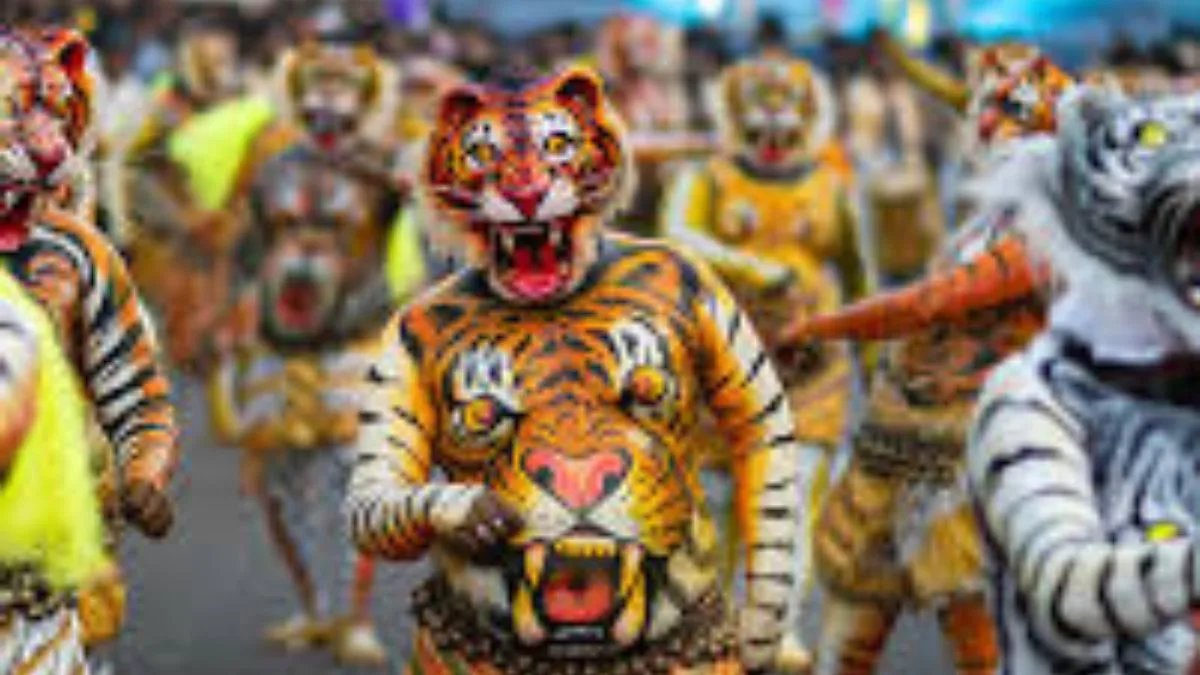
Human “tigers” descended on the stage at Shakthan, setting Thrissur ablaze with excitement as they entered the Swaraj Round. Around 450 performers, donning tiger masks and painted as majestic big cats, captivated the city with their dazzling Pulikali (Tiger Dance) on Monday evening. Big tigers, small tigers, big-bellied tigers, and tigers of varied colors moved in rhythm, drawing applause from thousands of spectators.
The festivities were flagged off at 4:30 pm on Monday at the southern gate of the Swaraj Round by Mayor M.K. Varghese. Teams from Veliyannur, Kuttankulangara, Yuvajana Sangham, Viyyur Shankarakulangara, Ayyanthole, Chakkamukku, Seetharam Mill, Naikkanal, and Patturaykkal participated in this year’s parade.
Advertisement
Among the highlights, the Ayyanthole group showcased a unique tiger umbrella, while Seetharam Mill Lane Desam presented a 3D digital *Pulivandi*—a first in the festival’s history.
Advertisement
For more than five hours, the tigers danced to the beats of traditional percussion instruments such as the thakil, udukkku, and chenda, as they paraded through Palace Road, Karunakaran Nambiar Road, Shornur Road, A.R. Menon Road, and M.G. Road before converging at the Swaraj Round.
Thrissur’s streets overflowed with thousands of spectators, including international tourists, eager to witness the spectacle. A delegation of tourism leaders from 10 countries, along with representatives from various Indian states, also attended the Pulikali celebration under the aegis of the Kerala Responsible Tourism Mission Society.
Pulikali, or the Tiger Dance, is one of Kerala’s most vibrant folk-art forms, celebrated on the fourth day of Onam. Performers paint their bodies in bold yellow, red, and black stripes to resemble tigers and dance to the rhythm of percussion. The tradition, which takes place at Swaraj Ground in Thrissur, draws both locals and visitors who join in the revelry.
The performers, known as Pulikalikkar, undergo special training to perfect the art of tiger-like movements. Their transformation involves intricate body painting, with dark yellow and black stripes that taper near the belly, and handcrafted masks made from paper, glue, bicycle tubes, and rattan. The finishing touches with conventional colors complete the lifelike tiger appearance, bringing this centuries-old art form vividly to life.
Advertisement