Explainer: Why is India making it harder for ISRO scientists to resign?
The memorandum, issued on July 14, was signed by SR Rajashekar, Joint Secretary (Personnel), Department of Space.
As the Bodoland Territorial Region (BTR) heads towards its council elections, the spotlight is turning to what the incumbent administration has delivered on the ground.




As the Bodoland Territorial Region (BTR) heads towards its council elections, the spotlight is turning to what the incumbent administration has delivered on the ground.
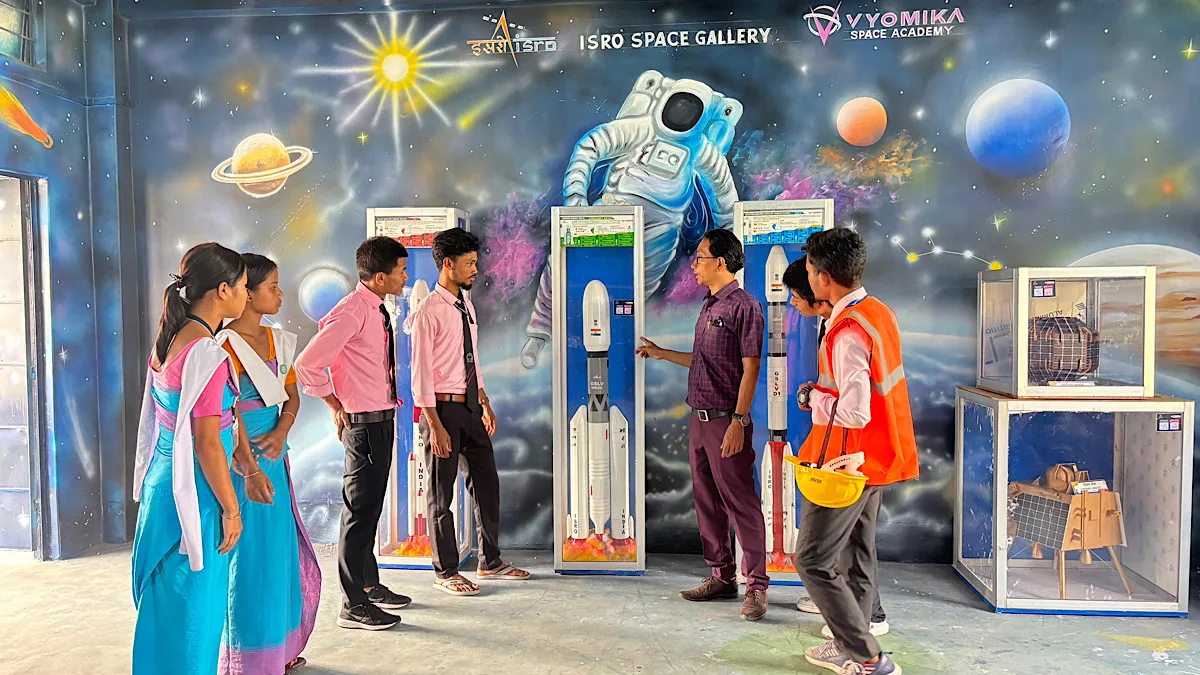
Among its showcase initiatives, the BTR government under Chief Executive Member Pramod Boro is highlighting a unique experiment in science education — the setting up of 15 School Space Labs across government schools in Bodoland.
Advertisement
Riding on the imagination of young minds and the growing public fascination with space science, the BTR has moved swiftly to make astronomy and rocketry part of the classroom experience. The “Bodoland Space Education Programme,” personally conceived by Boro, is being projected as a pioneering effort in the Northeast to bridge learning disparities and expose tribal students to cutting-edge STEM education.
Advertisement
The programme was launched in mid-2024, when the Chino Basumatary Memorial Space Laboratory was inaugurated at Sidli-Kashikotra Higher Secondary School in Chirang district. This was hailed as the first such lab in any government school in the region, drawing space experts and education leaders to the opening. Since then, the project has scaled rapidly, with 15 labs operational by August 2025 — a milestone marked during National Space Day celebrations, themed “Aryabhatta to Gaganyaan: Ancient Wisdom to Infinite Possibilities.”
The initiative stems from a Memorandum of Understanding between the BTR government and Vyomika Space Academy, a New Delhi-based ISRO “Space Tutor” partner. Vyomika has supplied curriculum, model launch vehicles, telescopes, CanSat kits, and mission-based teaching material, while also training teachers through bootcamps on how to align experiments with state syllabus and safely run rocket-building workshops.
For students in Bodoland, the labs represent a new horizon. “The thought of black holes swallowing light, galaxies stretching endlessly, or humans living on other planets sparks both wonder and determination,” said Prabhat Basumatary, father of 16-year-old Chittaranjan, a budding space enthusiast inspired by American astronomer Carl Sagan. Many of his peers dream of working with ISRO, NASA, or SpaceX, and their classrooms are filled with sketches of rockets, spaceships, and alien worlds.
Teachers, too, have felt the shift. “Students of our school are always excited to attend the classes at the Space Lab, and I am optimistic that our school will be able to produce space scientists of the future,” said Manju Boro, Principal of Sidli-Kashikotra Higher Secondary School. To create a sense of belonging, the BTR administration has attached memorial names to the labs, honouring educators and community figures in each town.
The labs themselves are designed for tactile learning. Instead of relying only on textbook diagrams, students now use optical telescopes for planetary observation, experiment with scaled PSLV/GSLV rocket models, conduct simulated launches with CanSat payloads, and test microcontroller-based telemetry systems. According to Vyomika, over 3,000 tribal students have already taken part in space-education activities — an indication that the labs are in active use, not just ceremonial showpieces.
For a region long associated with insurgency and underdevelopment, the image of teenagers in Bijni or Sidli aligning telescopes, debugging microcontrollers, and debating the mysteries of the universe carries both symbolism and strategy. By investing in science education, the BTR leadership is attempting to not only ignite curiosity but also reshape the narrative of Bodoland — from conflict to creativity, from struggle to stars.
Advertisement