Rajnath flags-in first-ever women circumnavigation expedition
Defence Minister Rajnath Singh on Monday flagged-in ‘Samudra Pradakshina’, the first-ever Tri-service all-women circumnavigation sailing expedition.
In a powerful call seeking strategic dominance, Defence Minister Rajnath Singh stated that in today’s evolving global landscape, the nation that defines the battlefield controls the conflict and its terms.




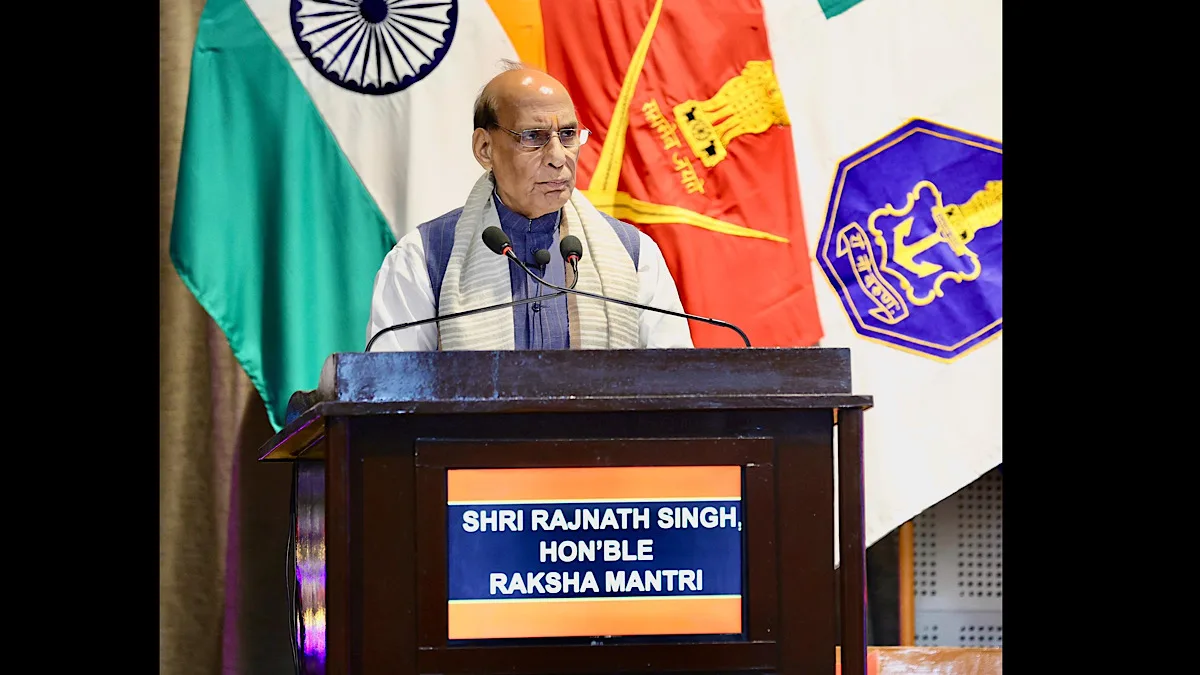
Defence Minister Rajnath Singh (photo:SNS)
In a powerful call seeking strategic dominance, Defence Minister Rajnath Singh stated that in today’s evolving global landscape, the nation that defines the battlefield controls the conflict and its terms. He urged India’s armed forces to take the lead in determining the battlefield and setting the rules of engagement, confirming that ”adversaries are forced to operate on our terms”.
Singh was addressing the gathering during the ongoing Ran Samwad-2025, being organised by the Headquarters Integrated Defence Staff, at Army War College in Mhow, Madhya Pradesh, here on Wednesday.
Advertisement
“Today, in the world, whichever nation decides the battlefield is the one that controls the game and its rules. Others have no option but to respond to this and step into the arena on terms that are not of their own choosing. Our endeavour must be to define the battlefield and the rules of the game ourselves, compelling the adversary to fight there, so that the lead advantage always remains with us,” he said.
Advertisement
Emphasising that India has never been a nation that seeks war or initiated aggression against anyone, Singh said that the present geopolitical reality is quite different. “Even though we do not harbour any aggressive intent, if someone challenges us, it becomes imperative that we respond with strength. To do so, we must continuously enhance our defence preparedness. We do not want anyone’s land, but we are ready to go to any extent to protect our land.”
Cautioning that in today’s era, wars have become so sudden and unpredictable that it is very difficult to predict when any war will end and how long it will last, the Defence Minister called for streamlining of the defence industry. “We must be prepared for this so that our surge capacity is sufficient. That is, if any war stretches for 2 months, 4 months, a year, 2 years, even 5 years, then we should be fully prepared for it,” he said.
Singh also stated that future wars will not merely be battles of weapons but a combined play of technology, intelligence, economy, and diplomacy. “In the times ahead, the nation that masters the triangle of technology, strategy, and adaptability will emerge as the true global power. To put it simply, this is the moment to learn from history and write a new one; this is the moment to anticipate the future and shape one.”
Drawing attention to the role being played by the technology in reshaping warfare globally, Singh said that in the present scenario, the element of surprise has become even more powerful. He said that with the rapidly advancing technology, by the time one is able to comprehend one innovation, another emerges, completely altering the course of warfare.
“The most striking feature of this element of surprise is that it no longer has a permanent form. It keeps changing, always carrying uncertainty with it. And it is precisely this uncertainty that confounds adversaries, often becoming the decisive factor in the outcome of war,” he added.
The Defence Minister stated that today, sheer numbers of soldiers or the size of weapon stockpiles are no longer enough, but the future of wars is being shaped by cyber warfare, artificial intelligence, unmanned aerial vehicles, and satellite-based surveillance. He said that precision-guided weapons, real-time intelligence, and data-driven information have now become the cornerstone of success in any conflict.
Citing the Russia-Ukraine conflict as a stark example, the Defence Minister stated that when the conflict started in 2022, it was primarily conventional warfare, including tanks, artillery, and rifles. The ground forces were engaged in hand-to-hand combat. But in three years, the nature of this war changed completely. Now we are witnessing that various types of war systems and doctrines are being deployed in this conflict, he said.
Admitting that Operation Sindoor provided “a wealth of lessons,” the Defence Minister said the conflict provided a glimpse of challenges and responses that could serve as valuable guidance for any conflict in the future. “I firmly believe that every war leaves us with some important learnings. In the course of battle, we are able to realistically assess the level of our preparedness,” he added. The Defence Minister also urged the armed forces to ensure that India’s information and cyber infrastructure is made even more robust.
Speaking about the ongoing seminar, the minister said that Ran Samvad is not merely an academic exercise but one that will further refine India’s strategic and diplomatic outlook. “The thoughts and conclusions emerging from this dialogue will not only strengthen our defence strategy but also make a long-term contribution to the nation’s overall security architecture and its path of development,” he added.
Advertisement