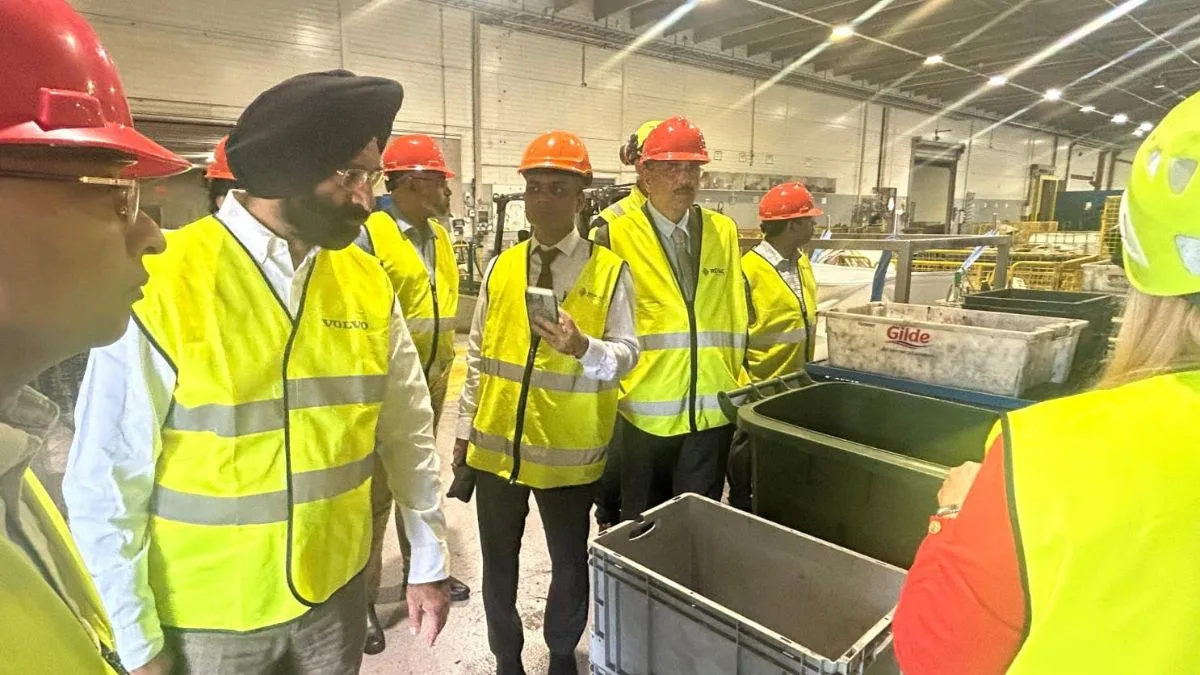
Delhi Environment and Industries Minister Manjinder Singh Sirsa on Monday visited Revac, an e-waste processing facility in Norway, to study how the country safely disposes of and recycles electronic waste.
According to an official statement, the minister toured the European plant to examine the infrastructure used for safely dismantling and segregating e-waste. He also learnt about the extraction techniques employed to recover reusable materials and convert waste into valuable products — a process that supports the circular economy.
Advertisement
Sirsa affirmed his government’s commitment to balancing industrial growth with environmental sustainability.
“As both the Environment Minister and the Industries Minister of Delhi, I will not allow either to suffer because of the other. Our goal is integrated progress — where clean industry fuels economic growth and safeguards the environment,” he said.
He also interacted with Revac’s senior engineers and operational heads to discuss technological adaptation, compliance, and community integration.
The minister highlighted the reasons for selecting Revac. In addition to its global reputation for eco-friendly e-waste management, the facility was chosen for its similarity in terrain and climate conditions to Holambi Kalan — the site of Delhi’s upcoming e-waste park.
The upcoming Eco Park at Holambi Kalan will be developed under a Public-Private Partnership (PPP) model, facilitated by the Delhi State Industrial and Infrastructure Development Corporation (DSIIDC), the department noted.
The statement further highlighted that the park is expected to generate over Rs 350 crore in revenue, create thousands of green jobs, and formalise Delhi’s largely informal and hazardous e-waste sector. The facility is being designed to handle all 106 categories of e-waste, as defined under the E-Waste (Management and Handling) Rules, 2022.
India is currently the third-largest generator of e-waste globally, and Delhi accounts for nearly 9.5 per cent of the national total. Recognising this urgent challenge, the Delhi Government is leading from the front under the broader mission of Viksit Bharat@2047, by investing in sustainable urban infrastructure that aligns economic opportunity with environmental responsibility.
“This is not just about waste,” said Sirsa, “it is about vision — of a Delhi that is clean, circular, competitive, and future-ready.”