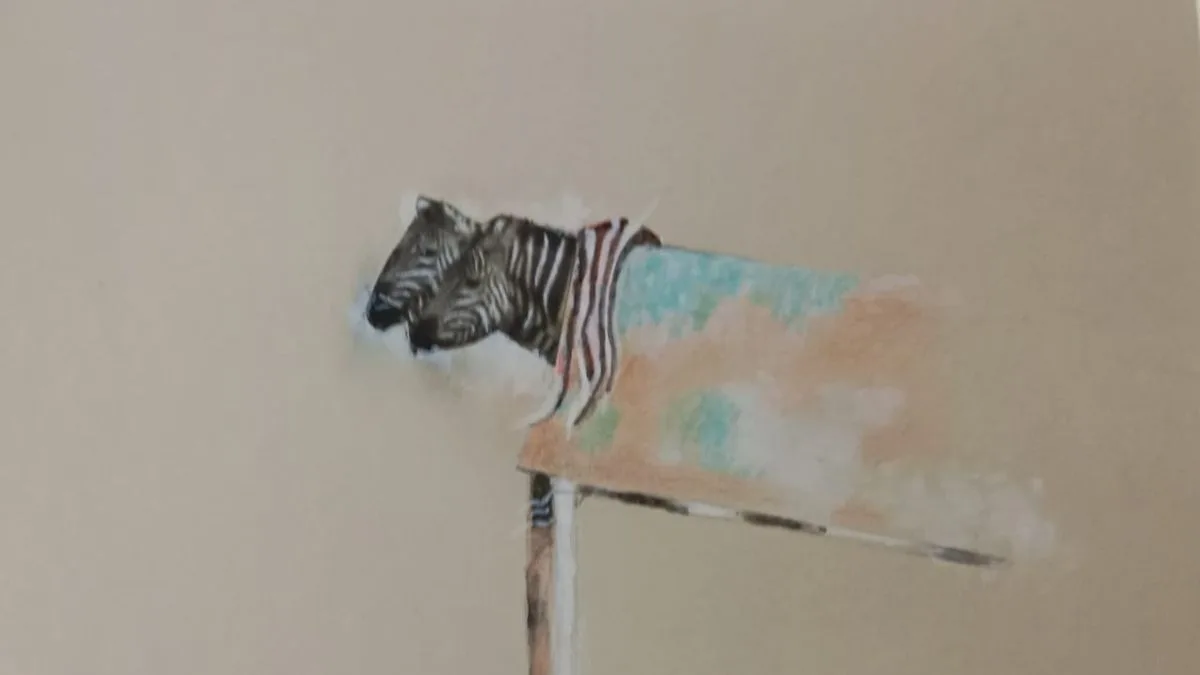
‘I didn’t visit Africa. Africa visited Me’, remarks artist Neeraj Bakshi, who was drawn to the continent after watching Out of Africa and reading Ernest Hemingway’s “Green Hills of Africa”. His art, while visually compelling, also confronts pressing issues like ecological destruction, poaching, and habitat loss.
A movie buff at heart, Bakshi says the vast African expanse instantly brought to mind the sweeping visuals of the film Lawrence of Arabia. “I was taken aback–was I on Earth or another planet?” he recalls. “Africa is the only place where I saw both the fury and the bounty of nature at the same time,” he said in an interaction with The Statesman.
Advertisement
In 1990, Bakshi left Kashmir as a refugee. “I stopped painting landscapes. My art turned stark,” he reflects. But Africa stirred something within. “There was a mystical connection between Kashmir and Kenya.” According to him, even their conflict histories — rooted in massacres — felt interconnected.
Talking about whether he feels his work was emotionally responding as if the animals were actually speaking, he added, “Always.” “My childhood cats in Kashmir, my Yorkshire–they’ve sat beside me and it always felt as if there was a conversation. Maybe it’s my artistic temperament. Even mythology suggests this–Durga’s lion, Egyptian cat gods–humans and animals have always shared a deep bond.”
To ensure his art does not just aestheticize the wild, but also captures issues such as poaching, habitat loss, and the greed of humans, Bakshi turns to his art. In one of his works, a cheetah–scared, looking back–is caught in a gaze with a half-visible hitman. In another painting of his, titled Gazing Each Other, he added a quote by The Cranberries: “We live for the love inside, living not for reality.”
He points to history: “From the caves of Altamira to Hindu gods, Egyptian and Greek mythology—animals were always there. Homo sapiens painted animals on caves as well.”
As someone who loves the wildlife, he said, “but it hurts. You kill a majestic creature for ivory–it’s tragic.”
He recalls a moment from 1998: accompanied by two Askaris (soldiers) who didn’t speak English, he asked if snakes were nearby. They said no. Later, as they climbed a shrub-laden mountain, they saw a massive python. “Hamari jaan nikal gayi (our hearts nearly stopped)”, he added.
Citing inspirations like Hemingway, Joy Adamson, and Robert Vavra, he traces how African and Kashmiri folklore converge. He also recalled a Masai tribesman’s performance, where he mimicked a monkey– how it wailed and the way it walked. It powerfully reflected the deep co-existence between man and animal.
He also points out that Picasso’s cubism was shaped by African masks. “Even Amedeo Modigliani drew from Africa,” he added.
With deforestation accelerating climate change and natural corridors shrinking, Bakshi remarked, “When forests vanish, animals suffer–and eventually, so do we.”
When asked about the future, he said, “African art and Kenya–it’s a lifelong endeavour.” He added, “Africa leaves such a glossing impression on me that it always comes back.”
Recalling Masai Mara, he shared, “We reached at night, and at 5 a.m., they took us to see animals–cheetahs, Zebras etc. The beauty was breathtaking. The great migration had begun, it was August. That scene–I can’t forget it for life. It left a lasting impression on my psyche.”
Looking ahead, Bakshi plans to donate 15% of his art sales to wildlife conservation and hopes to work for stray animal welfare. His upcoming exhibition, Africa Impressions II, will be held in both India and Nairobi, where he also spends time at his art studio.