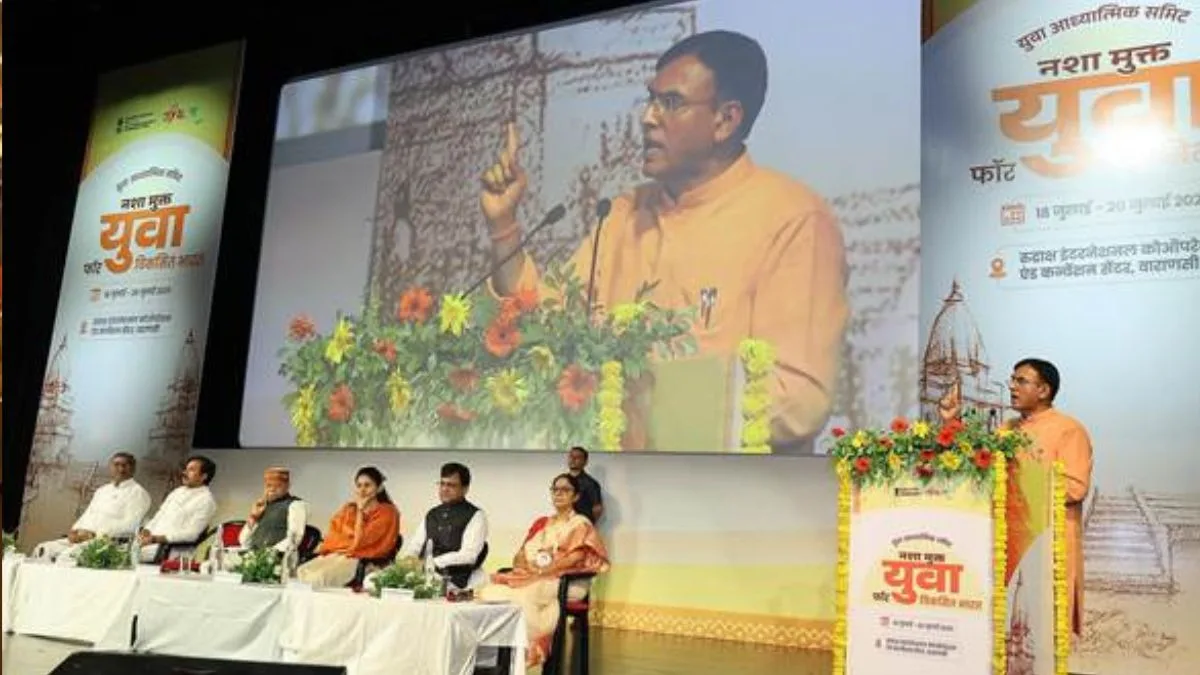
The Youth Spiritual Summit on the theme Nasha Mukt Yuva for Viksit Bharat culminated here on Sunday with the formal adoption of the Kashi Declaration, a defining moment in Bharat’s journey towards a drug-free society by 2047.
Organised by the Ministry of Youth Affairs and Sports, the Summit brought together more than 600 youth leaders, representatives from over 120 spiritual and socio-cultural organisations, academicians, and domain experts.
Advertisement
The event marked a defining moment in Bharat’s journey towards a drug-free society by 2047.
This gathering represented a national convergence of youthful energy, spiritual vision, and institutional resolve.
The Summit featured four focused plenary sessions that explored key dimensions of substance abuse: its psychological and societal impacts; the mechanics of drug trafficking and supply chains; strategies for grassroots awareness campaigns; and the role of spiritual and cultural institutions in rehabilitation and prevention.
These deliberations formed the foundation of the Kashi Declaration, which is a visionary commitment to collaborative action against drug addiction, rooted in India’s civilisational wisdom and youth leadership.
Speaking at the Summit, Union Minister of Youth Affairs and Sports, Dr. Mansukh Mandaviya, emphasised: “We have reflected deeply over the last three days across diverse thematic sessions. Based on this collective chintan, the Kashi Declaration is born, not just as a document, but as a shared Sankalp for the Yuva Shakti of Bharat.”
These deliberations laid the intellectual and moral foundation of the Kashi Declaration, uniting diverse voices into a common national direction. The Kashi Declaration, formally adopted on Sunday, affirms a national consensus to treat substance abuse as a multi-faceted public health and societal challenge, and calls for a whole-of-government and whole-of-society approach. It emphasises the integration of spiritual, cultural, educational, and technological efforts to prevent addiction, support recovery, and foster a national culture of sobriety. It proposes institutional mechanisms for multi-ministerial coordination, including the formation of a Joint National Committee, annual progress reporting, and a national platform for linking affected individuals to support services.
Building on the spiritual foundation of the summit, Dr. Mandaviya added, “Bharat’s spiritual strength has always guided Bharat through its crises. This is why spiritual institutions must now lead the charge in creating a Nasha Mukt Yuva for Viksit Bharat. They will serve as the backbone of this Maha Abhiyan.”
Echoing this spiritual ethos, Governor of Himachal Pradesh, Shiv Pratap Shukla, reflected on the cultural sanctity of the venue: “This sacred land of Kashi is the cradle of Sanatan Chetna (eternal consciousness), where discipline and values guide life’s journey towards moksha. We are not just gathering; we are sowing seeds that will one day grow into a strong tree of national transformation.”
He further cautioned: “If a nation where 65% of the population is youth falls prey to addiction, only those who break free from it will be able to build the future.”
The culminating session of the Summit was marked by the presence of several distinguished dignitaries. The keynote address of Session 4 on the final day was delivered by Nitin Agarwal, Minister of State (Independent Charge) for Excise and Prohibition, Government of Uttar Pradesh.