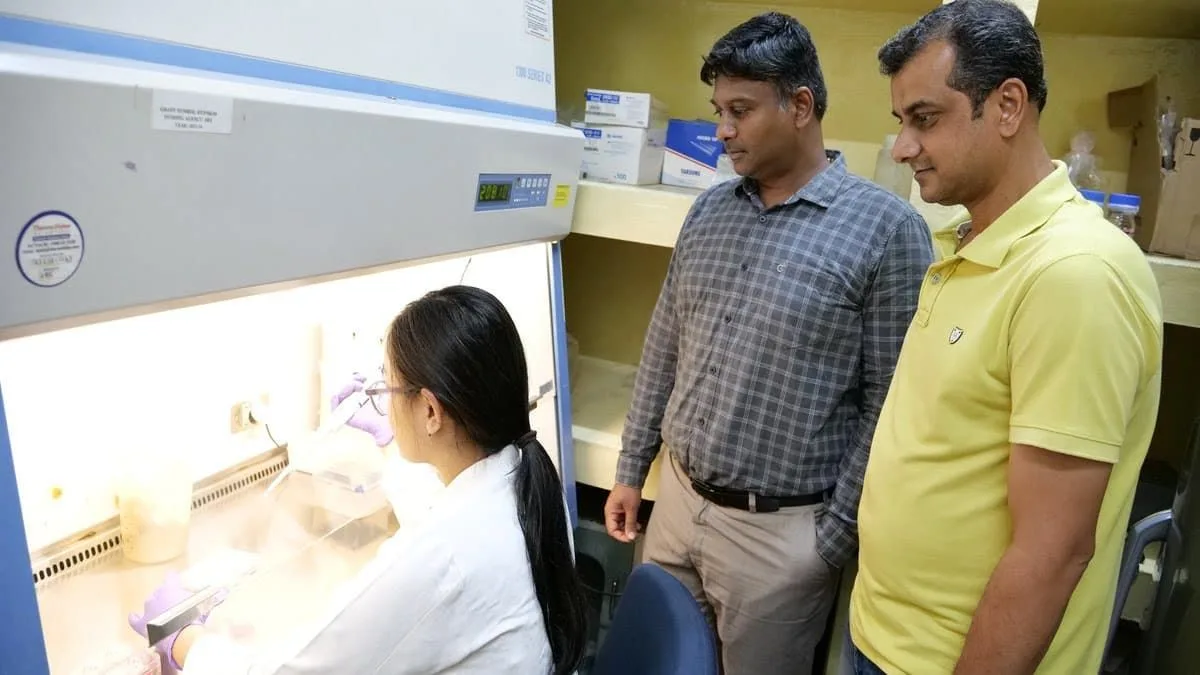
As India confronts a fresh wave of COVID-19 infections—with active cases surpassing 5,000—scientists at the Indian Institute of Technology (IIT) Guwahati have unveiled a breakthrough method for detecting the SARS-CoV-2 virus, offering a timely and cost-effective alternative to conventional diagnostic tools.
The novel technique, detailed in the journal Applied Clay Science, is built on a surprisingly simple principle: sedimentation.
Advertisement
Researchers discovered that the rate at which a clay-virus-electrolyte mixture settles can be used to detect the presence and concentration of viruses, including SARS-CoV-2, which causes COVID-19.
Unlike expensive and resource-intensive testing methods such as RT-PCR, antigen, and antibody tests, this new method is both accessible and affordable—making it especially valuable in low-resource settings.
At the heart of the innovation is Bentonite clay, a naturally occurring substance already known for its ability to absorb pollutants and bind with organic materials.
Bentonite’s unique negatively charged structure makes it an ideal candidate for interacting with virus particles.
Earlier research had shown its potential to bond with bacteriophages and other viruses, laying the groundwork for this new diagnostic application.
In the current study, scientists from IIT Guwahati tested how Bentonite clay behaves when mixed with virus surrogates and the Infectious Bronchitis Virus (IBV) in a controlled salt environment.
Conducted at room temperature and a neutral pH of 7, the experiments showed that the viruses effectively adhered to the clay particles, altering the sedimentation process in measurable ways.
“Imagine detecting viruses just by watching how fast clay settles in water—that’s essentially what we’ve achieved,” explained Prof. T.V. Bharat of the Civil Engineering Department at IIT Guwahati.
“By observing this process, we can not only identify the presence of viruses like SARS-CoV-2 but also estimate their concentration with accuracy.”
He added, “This approach can revolutionize how we monitor viral outbreaks—it’s quicker, cheaper, and still precise. That’s a big step forward for public health systems, especially during global health crises.”
The research team confirmed that the clay-based detection method showed high accuracy when compared with established testing protocols, bolstering confidence in its reliability.
Given its simplicity and scalability, the method holds promise for rapid screening in rural and underserved areas, especially in future pandemic preparedness efforts.
The development comes at a crucial time when health authorities are once again on alert. While the current surge in cases is being closely monitored, innovations like IIT Guwahati’s clay-based test could significantly ease the burden on healthcare infrastructure and improve early detection strategies.