As world’s arid lands occupy 3,400 million hectare, there is a pressing need for applied research to create technological packages for Indian Prosopis species, mainly Khejari in sandy desert for genetic improvement of thornless, erect, fast-growing, insect/disease resistance and high production of palatable pods. For this, incorporation of Prosopis into carbon sequestration/global climate change programmes is a must.
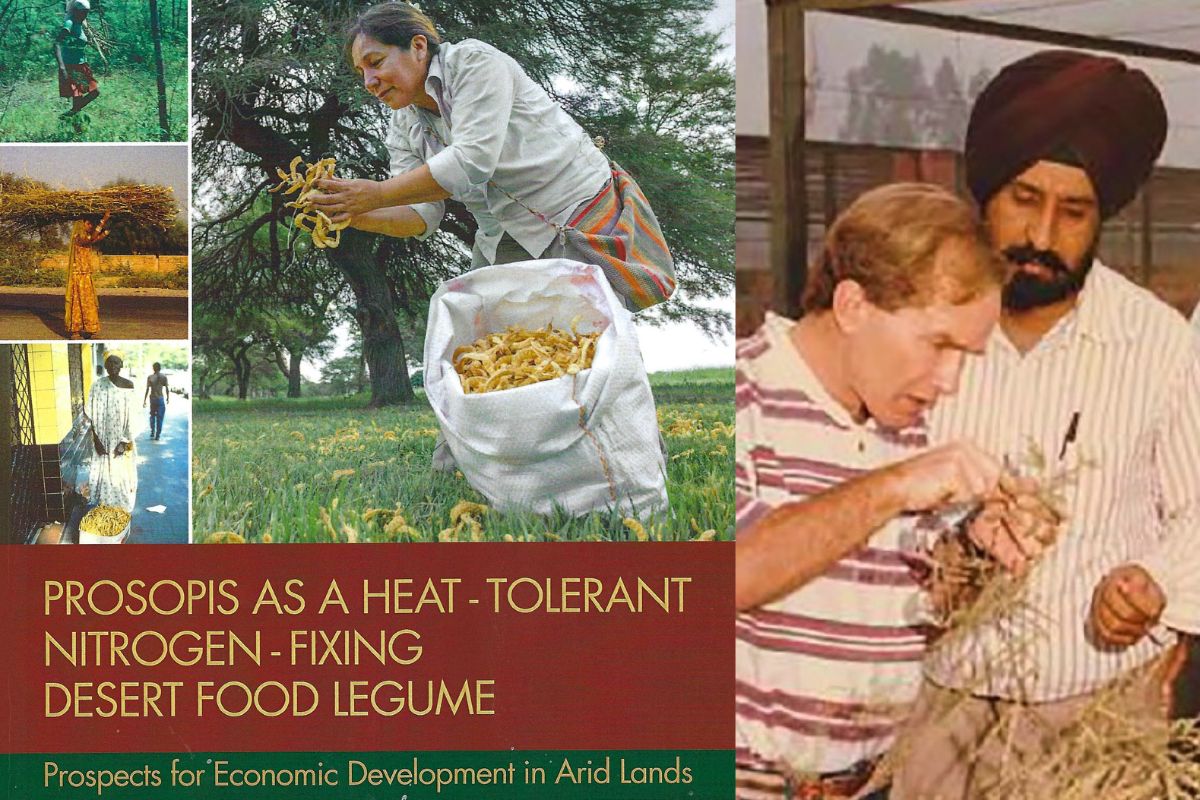
Dr. Peter Felker, a world renowned plant scientist and biotechnologist known as “Mesquite Man” in the USA. Speaking to SNS, he defined Prosopis as an empowering forest resource in service of science. Being a heat resistant nitrogen fixing desert food legume it is beneficial to humanity. Mesquite is a common name for several plant species in the genus Prosopis. It contains over 40 species of small leguminous trees.
Advertisement
The world’s arid lands of 3,400 million hectare are home to 800 million people of the countries with the lowest per capita income, education, health standards and prone to mass starvation and animal mortality due to low rainfall. Dr. Felker who is now President of Casa de Mesquite and is building a factory in Argentina to produce international food quality flour from the pulp of Prosopis pods with an aim to improve the living condition of such hapless people.
Not only is the rainfall low but the soils are also 10 times lower in soil carbon, nitrogen, and inherent fertility than temperate farmlands. Unlike potassium, calcium, or phosphorus, nitrogen does not exist as a mineral in the soil but is an indispensable element for protein and the growth of living matter. Prosopis is a leguminous plant capable of regenerating soils by nitrogen fixation.
Dr. Peter Felker and Maria Cecilia Puppo, a senior scientist of National Council of Scientific and Technical Research (CONICET) and UNLP in Argentina, have recently came up with a book titled : Prosopis As A Heat-Tolerant Nitrogen Fixing Desert Food legume: Prospects for Economic Development which published by Academic Press (USA). This book carried research chapters of a group of Indian scientists including Dr Gurbachan Singh of GSFRED in Karnal and Dr J C Tiwari of CAZRI, Jodhpur.
Elaborating on the importance of Propsopis (Mesquite) as heat-tolerant nitrogen fixing desert food legume, Dr Felker said, “There can be no Carbon Sequestration without Nitrogen as the C/N ratio is 12. In arid lands only 2 kg of Nitrogen comes out into the ecosystem every year in rainfall. If only 2 kg comes in, only 2 kg can come out. As Prosospis fixes 50 kg of Nitrogen per hectare, it means 600 kg of C-Sequestered per year. Given the huge surface of arid zones 600 kg/ha per year is a globally significant amount. I think Nitrogen fixers worldwide are the most rapid and cost efficient way to sequester carbon”.
Prosopis, an empowering forest resource in the service of science for humanity, would provide the Nitrogen for intercrops or pastures to greatly improve crop yields or livestock carrying capacities. Unlike Argentina which has several extensive range-wide germplasm collections of P. alba, P. chilensis, and P. flexuosa, no single collection of seeds from representative P. pallida in Peru exists that could be field-tested in areas most in need of nitrogen, human and livestock food across Latin America Haiti, Sahelian Africa, and the Indian subcontinent, according to Dr Felker.
Underling to build more ecologically and economically sustainable arid ecosystems for a more peaceful world, Felker who has Prosopis germplasm across from the countries, says, “Peace is a very precious commodity. We scientists who are well fed, clothed and sheltered and privileged to not be away from our families in an armed conflict, would be well to dedicate a portion of our scientific energies to the resolution of poverty in arid lands. As General Colin Powell former Chief of Staff of US Armed forces stated ‘The war against terror is bound up in the war against poverty’.”
Dr. Felker and Dr. Puppo, providing knowledge through their book, have also dealt with potential for alleviation of poverty elimination and ecosystem stablization in Sahelian Africa by Peruvian Prosopis, applied genetic research in asexual reproduction, molecular markers, plantation establishment and management techniques for both lumber and pods (canopies that permit mechanized pod harvest) and intercropping/grazing.
They suggest developing markets for ground Prosopis pods for livestock feed, wood chips from small diameter (< 10cm) thorny trees that have become invasive, and high value-added lumber products from small-diameter short logs that are sufficiently large to have significant macro-economic impacts.