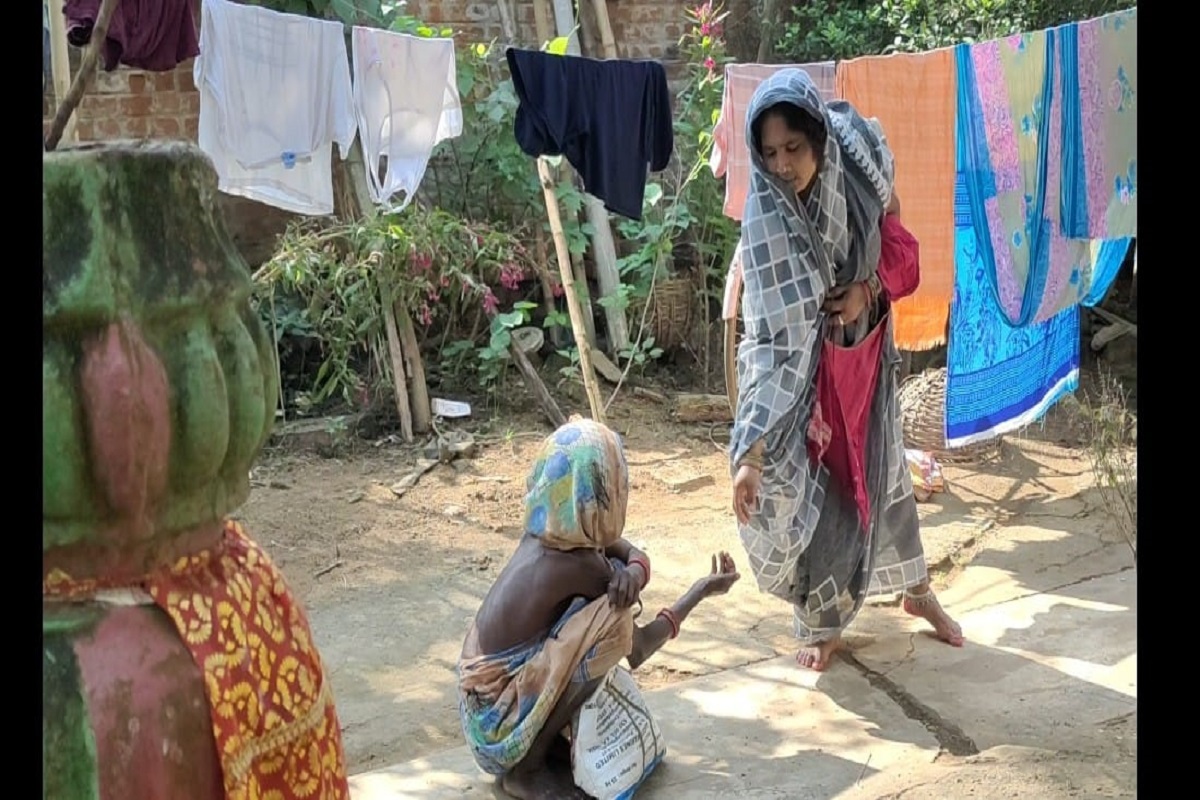
The Great Indian Kitchen, a recent Malayalam film, very aptly depicts the inadequately addressed oppression of women in our kitchens. Women have traditionally been expected to remain confined to their socially prescribed household roles. A particular sequence of the film shows a very poignant reality that is relevant to the subject of this piece. Like million other original migrants, a newlywed woman starts her life in the adopted household. From the first day itself, family members savour the delicacies cooked by the newlywed. However, no one cares about the issues that she has to face day in day out and turn a blind eye to the issues she starts facing. In one such incidence, a drain is blocked in her kitchen, leading to a foul smell and an extremely unhygienic situation which makes her vomit the moment she enters the kitchen. While she raises this immediately to her husband and subsequently keeps reminding him, he keeps forgetting it, and very conveniently so. And why wouldn’t he? For him, the blocked drain changes nothing. He continues to get his lunch-pack in time, his clothes are pressed before he emerges from his shower, and so on.
Others in the family are also not helpful. The aged father-in-law touches sambhar only if it is prepared in an earthen pot on a traditional Chulha. It doesn’t occur to him that the well-educated bride has to spend a large part of her day in a smoky room.
Advertisement
In traditional Indian households, decisions, important or otherwise, are normally taken not by those who face their consequence. Because of this asymmetry in this household-level power dynamics, women have hardly been the decision-makers for even choosing the cooking fuel for their kitchens. Programmes like Pradhan Mantri Ujjwala Yojana (PMUY) and Direct Benefit Transfer attack at the root of this asymmetry. The connection is only given to women from poor families and the subsidy amount is credited to their bank accounts directly.
Advertisement
Since PMUY’s launch in May 2016, 9 crore connections have been given under the scheme. The scheme has made a definitive contribution in improving India’s performance on Sustainable Development Goals-SDG 3 (Good Health and Well-being) and SDG 5 (gender equality) and specially SDG 7, which aims to ensure access to affordable, reliable, sustainable, and modern energy for all. The contribution of Ujjwala Yojana may be seen in the Fig-1 and Fig-2.
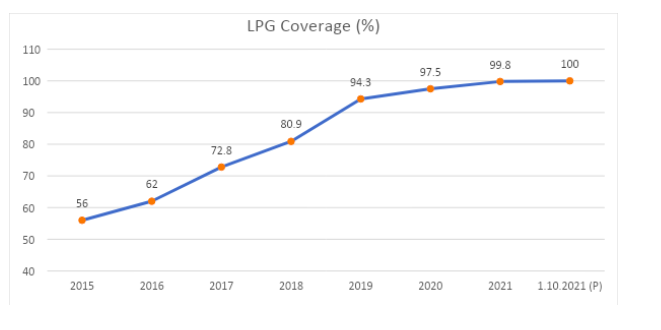
Fig 1 : Progress in LPG coverage in the country ( Source : PPAC)
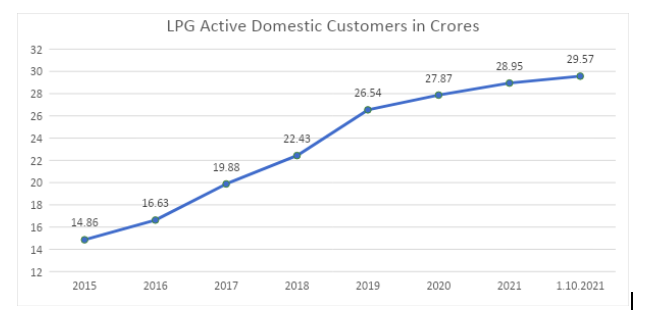
Fig 2: Number of active LPG consumers in the country ( Source : PPAC)
There is wide agreement now that Pradhan Mantri Ujjwala Yojana is not just a clean cooking energy access programme, it is also an instrument to achieve women empowerment. While the upfront economic barrier removed by PMUY is an obvious benefit of the scheme, some far more impactful but less obvious benefits have been found by various independent studies. TERI’s Policy Brief on “Clean Fuel for Cooking: Solution to Achieve Better Air Quality” mentions that switching from 100 % dung-based cooking to 100 % LPG for cooking reduces the human exposure rate (PM 2.5) by about 93 % (from 516 μg/m3 to 35 μg/m3). The study confirms the view that LPG is a far eco-friendlier fuel, despite belonging to the fossil fuels family. In another paper, Tripathi and Sagar (2019) estimate the cost of economic loss per non-LPG household due to health burden arising from household air pollution at about Rs 69000 per year (calculated using USD/INR at 69). Clearly, the benefits of using LPG full-time for cooking far outweigh the cost borne by the consumer.
In its new phase launched recently, Ujjwala 2.0 focuses on migrants, an important category of women who were relatively left out of government entitlements. Most of these migrants are engaged in unorganised sectors and earn their livelihoods doing odd jobs. Women working as domestic help constitute a significant share out of these migrants. Time is precious for them, the more time they save from doing their household chores, the more they can earn. Let’s discuss the story of one such woman.
Reeta (name changed), had migrated to Punjab with her husband a few years back. She worked there as a labourer. When things didn’t work out well with her husband, she came back to Lucknow, her maternal home and started working as a domestic help in several houses. She had heard about Ujjwala from many, but never applied for it. She thought since she does not have any local address proof, she will not be able to get an Ujjwala connection. Reeta has an AADHAR card and a bank account both registered in Punjab. Her bank has recently been merged with another bank and so she believed that her bank account was no longer working. She has no document as an address proof.
She had been trying unsuccessfully for a few months to get her AADHAR address updated and to get her bank account transferred. Given most of her mornings and afternoons were spent in working, she was not able to find time to pursue the updation of her key documents systematically.
However, things changed swiftly for her after the launch of Ujjwala 2.0. She got an Ujjwala 2.0 connection under the migrant category. She just had to submit a copy of her Punjab AADHAR card and a simple self-declaration for her current address.
Ujjwala 2.0 solves the address-proof problem for millions of migrants like Reeta. The documentary requirement for migrant applicants has been relaxed to a bare minimum. They can simply submit a copy of their Aadhaar card for identity and a simple self-declaration as proof of address and declaration of family.
Similarly, Ranjeeta (name changed) who lives in Navi Mumbai and like Reeta, works as domestic help, got an Ujjwala 2.0 connection. She has an AADHAR card of West Bengal. Her husband had left her and she now lives with her two young daughters. She opted for two 5 Kg cylinders connection as the upfront cash expense each month is lower in this option. Gradually Rising patronage of the 5 Kg connection is a testimony to its popularity because of the convenience it provides.
With women like Reeta and Ranjeeta part of the clean cooking ecosystem now, India is on track to achieve the targets under SDG 7.1 i.e., universal access to affordable, reliable and modern energy services. In fact, out of a total of 99 lac connections given across the country under Ujjwala 2.0, more than 2.5 lac connections have been availed by migrants and as word-of-mouth spreads about this innovative and citizen-centric policy tweak, more migrants are expected to onboard Ujjwala 2.0.
Ujjwala 2.0 has greatly simplified the application form and applicants can apply online as well as at nearest distributors. Additionally, all beneficiaries are being provided free stoves and first refills to incentivise LPG ecosystem onboarding and make it a smooth and hassle-free experience. Considering the tremendous response to the scheme, the government has recently extended the scheme for the release of another 60 lac connections which will lead to a total of 9.6 crores Ujjwala beneficiaries.
LPG which was introduced in the country in 1950s was perceived as an urban luxury not till very long ago. Ujjwala has changed this forever. Programmes like Ujjwala are relatively small in their financial outlays but epochal in the transformation they bring into the lives of ordinary citizens. Interventions like these crank the engines of social change taking us closer to the India of our dreams.
Kushagra Mittal, Deputy Secretary at Ministry of Petroleum and Natural Gas and
Nidhi Prabha Tewari, Sr Social Sector Specialist, Ujjwala – MoPNG
Views are personal
Advertisement