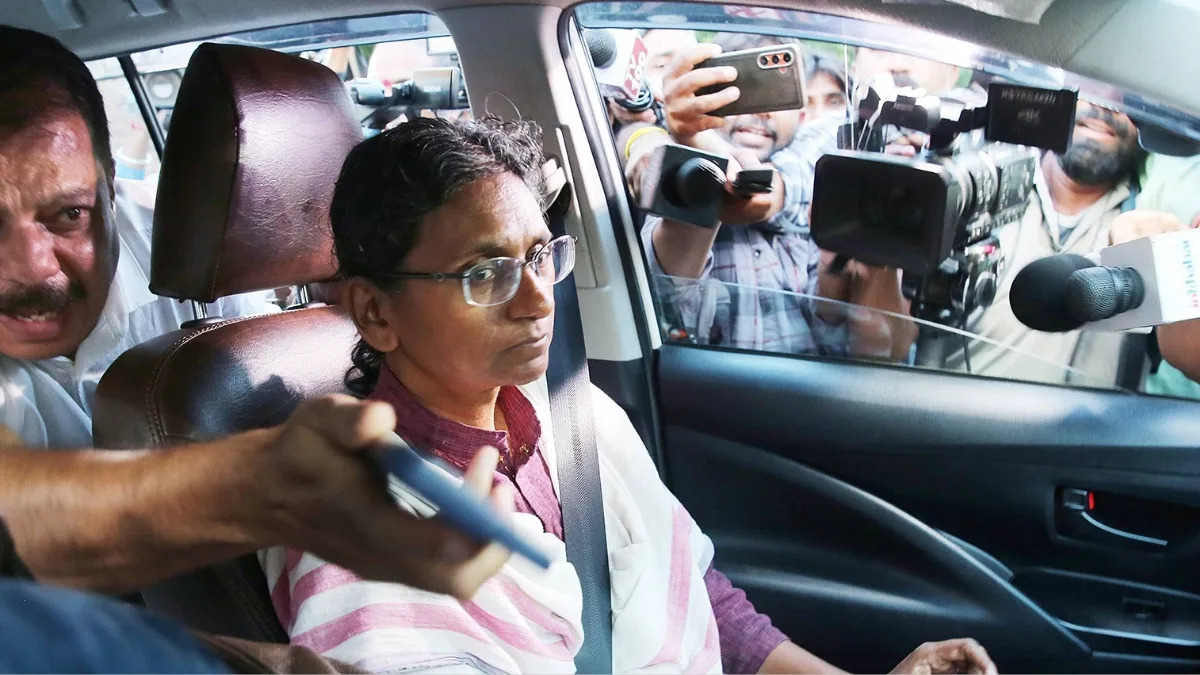
Bangladesh: Woman, teenage daughter gang-raped during robbery in Cox’s Bazar
A gang of eight to 10 robbers entered their residence after cutting through the window grills, an official said.
The Tiger of Bengal sudipta chatterjee WHEN then Viceroy and Governor-General of India Lord Curzon peremptorily requested Sir Ashutosh Mookerjee…





The Tiger of Bengal
sudipta chatterjee
WHEN then Viceroy and Governor-General of India Lord Curzon peremptorily requested Sir Ashutosh Mookerjee to visit England so that Britons could get some glimpses of the scholars produced by British education in India, he declined. All because his mother refused to allow him to make that sea voyage. Even when Curzon decreed, “Tell your mother the Viceroy and Governor-General of India commands her son to go,” Asutosh didn’t hesitate and replied, “Then I will say that Ashutosh Mookerjee refuses to be commanded by any other person except his mother, be he Viceroy or be he somebody higher still.”
Perhaps this instance of his characteristic defiance of the powers-that-were was based on the strength of his enormous devotion to his mother. For his distinctive uncompromising attitude towards the British government, his exemplary courage, profound self-esteem and enduring academic integrity, this celebrated Bengali academician and illustrious educator – born on 29 June 1864 — came to be dubbed the “Tiger of Bengal”.
The Asutosh Mookerjee Memorial Institute, established in 1927, is overseeing the celebration of his sesquicentennial birth anniversary from June 2013 in collaboration with Calcutta University and the state Government. Sir Asutosh&’s massive ancestral residence — a heritage building at 77, Asutosh Mookerjee Road — presently houses the Memorial Institute under whose aegis the Asutosh Memorial Library was established in 1927 and Asutosh Memorial Hall was set up in 1935, adjacent to the library.
One of the most dynamic entities of the evolution of Indian education, Sir Ashutosh Mookerjee (1864-1924) was of a towering personality and remarkable managerial acumen. Son of the well-known doctor, Ganga Prasad Mookerjee, founder of South Suburban School in Kolkata, and father of the famous Syama Prasad Mookerjee, founder of the Bharatiya Jana Sangh, he was born in Bowbazar in the heart of the city. Brought up in an atmosphere of science and literature at home, the young Asutosh exhibited an early aptitude for mathematics.
When he was still young, he met Pandit Ishwar Chandra Vidyasagar, who was a source of major inspiration. In 1879, when he was just 15, he passed the entrance exam of Calcutta University. In 1880, he was admitted to the widely famed Presidency College and had luminaries like PC Ray and Narendranath Dutta (later Swami Vivekananda) as classmates. In 1883, he came first in the BA examination at Calcutta University and was awarded the Premchand-Roychand scholarship to complete a postgraduate degree in mathematics. In 1885, he majored in mathematics and also acquired a postgraduation in physics, becoming the first student to be awarded a dual degree from Calcutta University. In 1886, he did his Masters in physical science. Rejecting a job offer in the Department of Public Instruction for the purpose of completing his Bachelor of Law degree, he found the time to publish prolific papers on issues in mathematics and physics.
Lord Curzon&’s education mission in 1902 identified the universities, and Calcutta University especially, as centres of sedition where young people formed networks of resistance to colonial domination. The cause of this was considered to be the granting of autonomy to these universities in the 19th century. Thus, during 1905-1935, the colonial administration tried to reinstate government control of education.
At the age of 24, Ashutosh Mookerjee had become a Fellow of Calcutta University and soon transformed it into a great teaching and research institution. He had an eye for talent and among his “discoveries” were Dr CV Raman and Dr S Radhakrishnan. He became the Indian vice-chancellor of the University of Calcutta for four consecutive two-year terms (1906-1914) and a fifth two-year term (1921-23), dominating university affairs throughout his life. In 1923, however, when Lord Lytton tried to impose conditions on his reappointment as vice-chancellor, Mookerjee indignantly refused the post.
Mookerjee was responsible for the foundation of the Bengal Technical Institute in 1906 and the Calcutta University College of Science in 1914. The Calcutta Mathematical Society was also founded by him in 1908 and he served as its founder president during 1908-1923. He was the first president of the inaugural session of the Indian Science Congress in 1914 and South Suburban College was renamed Asutosh College in 1927.
Mookerjee had an innovative vision about the kind of education youth needed and he had the insight, tenacity and grit to wrest the requisite resources from his colonial masters. He set up several new academic graduate programmes, like comparative literature, anthropology, applied psychology, industrial chemistry, ancient Indian history and culture as well as Islamic culture. He also made arrangements for postgraduate teaching and research in Bengali, Hindi, Pali and Sanskrit. The diverse range of subjects offered by Calcutta University today is evidently the harnessing of his concerted efforts. Scholars from all over India, irrespective of race, caste and gender, came to study and teach in the university. He even persuaded European scholars to teach at his university. For his contribution to education, the government of India issued a stamp in his honour in 1964.
Mookerjee was a member of the 1917-1919 Sadler Commission, presided over by Michael Ernest Sadler, which investigated the status of Indian education. He was three times president of the Asiatic Society and in 1910 of the Imperial (now National) Library Council. He donated his entire personal collection of 80,000 books to the library. Learned and conversant in Pali, French and Russian, he was awarded the titles of “Saraswati” and “Shastravachaspati” by the pandits of Bengal for his service to Indian education. Mookerjee was appointed a Companion of the Order of the Star of India in June 1909 and knighted in December 1911.
The fight never went out of Sir Ashutosh Mookerjee, in spite of all the opposition he faced because of his innovative dreams. “Great spirits have always encountered violent opposition from mediocre minds,” Einstein had once remarked famously.
Sir Ashutosh died suddenly in 1924 at Patna, soon after losing a fiercely contested Hindu law inheritance case to the Shia Bihari barrister, Syed Hasan Imam. The epitaph beneath his marble bust at the Ashutosh Museum of Arts at the University of Calcutta reads, “His noblest achievement, surest of them all/A place for his mother tongue — in his stepmother&’s hall”. French scholar Sylvan Levi&’s observation makes fitting conclusion, “Had this Bengal Tiger been born in France, he would have exceeded even Georges Clemenceau, the French Tiger.”
Advertisement
Advertisement
Advertisement