‘No point’: Vladimir Putin rejects Volodymyr Zelenskyy’s offer to meet
Vladimir Putin's response came after Zelenskyy wrote an "open letter" to the Russian President.
Flanked now by two modern buildings on Nrupathunga Road, Bengaluru, stands a quaint-looking hundred-year-old colonial architectural beauty, with its impressive,…




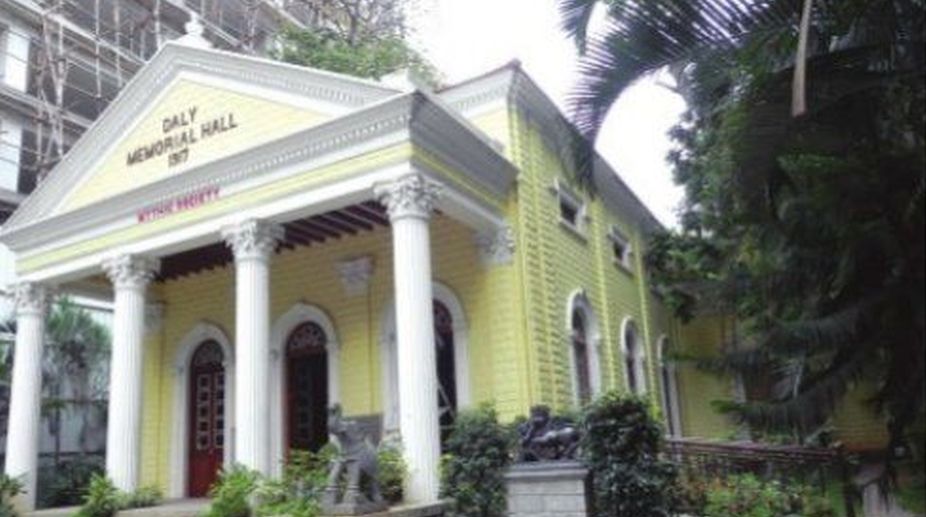
Flanked now by two modern buildings on Nrupathunga Road, Bengaluru, stands a quaint-looking hundred-year-old colonial architectural beauty, with its impressive, fluted Corinthian columns —the Daly Memorial Hall, 1917. Even more intriguing is the inscription below — Mythic Society. Mounted on a pedestal on the right of the stone steps leading to the stone verandah and the glass- panelled wooden doors that usher one into the hall is the emblem of the society, a piece of Hoysala sculpture.
Welcoming one up the stone steps, on either side are two identical stonecarved elephant figures. The building itself is constructed in the classical Graeco- Roman architectural style with a cruciform plan. The high-roofed hall is like many other colonial and neo-colonial buildings in Bengaluru covered in red Mangalore tiles. The approach to the Hall itself, in the unique combination of sculpted oriental artefacts displayed against a distinctly European architectural background, encapsulates the ideal meshing of cultures and civilisations that the Society upholds.
Advertisement
Though the foundation stone of the Hall was laid by the Maharaja of Mysore, His Highness Krishnaraja Wodeyar Bahadur on 30 August, 1916, it was opened on 25 July 1917 by the Yuvaraj Narasimharaja Wadeyar. The granite plaques, on either side of the central wooden door leading into the high roofed hall, commemorate these significant events. The Hall and adjoining anteroom that earlier housed the Library is named after Sir Hugh Daly (1860-1939), the British resident of Mysore state and the Chief Commissioner of Coorg.
Advertisement
The land on which the hall and Library are located was donated by the visionary Maharaja of the erstwhile Mysore State. This became the premises of the Mythic Society established in 1909 (incidentally, the same year as the establishment of the Indian Institute of Science, Bangalore) as a pioneering institution for the study of Indology, broadly speaking Indian culture and civilisation, art, architecture and sculpture, religions and philosophy, literature and languages. FJ Richards, the Collector of Bangalore Cantonment District, was enthusiastic in setting up the Society with the active participation of both European and Indian residents.
Like the Asiatic Society of Bengal (established 1784), The Asiatic Society of Bombay (established 1804) and the Madras Literary Society ( established 1817), the Mythic Society of Bangalore encapsulated a shared vision of deciphering, understanding, archiving, documenting oriental culture and scholarship as a whole. Each of these institutions began as idealistic dreams of European orientalist scholars who even solicited funds and space from liberal-minded donors to give shape to a concept of preserving oriental art, writing, architecture, languages and facilitating an exchange of thought and ideas between the Orient and the West.
The Princely State of Mysore played a stellar role in donating land for the Hall and Library and setting up a corpus fund for the erection of the building. Among those who donated generously towards the construction of the premises, were among others, the rulers of Baroda, Burdwan, Travancore and the Begum of Bhopal and even individuals like Dorabji Tata, Ashutosh Mookerjee, Mokshagundam Visvesvaraya. All donors, patrons, mentors are duly commemorated through portraits hung up on the walls just below the ornamental frieze going round the ceiling of the Hall. The anteroom displays on wooden plaques a chronological list of names of presidents of the society beginning with Dr Morris Travers who later became the Director of the Indian Institute of Science, Bangalore.
The library, earlier housed in this building, and now shifted to a more modern and spacious space adjoining the heritage hall, has a collection of over 44,000 books and journals. In fact, the Quarterly Journal of the Mythic Society is being published regularly since its inception in 1909. The nucleus of the library collection began ith the books donated by Reverend Father Anthony Marie Tabard, a French priest who had arrived in the city in 1886 (as a teacher in St Joseph’s College), who was later appointed chaplain of St Patrick’s Cathedral Church (later a Parish Church) and was one of the founding members of the Society. Other private collections donated by eminent citizens added to this tranche of books. The Mysore Secretariat Library was duly merged with this collection, which still has a good archive of old maps of Bangalore and original source material for research in several fields of art and humanities.
I found the little-known Bengali links with the Society of special interest. Themost memorable link was the lecture on “Folk Religion in India” delivered by Rabindranath Tagore on 8 March 1919 in the Daly Memorial Hall. The text of that lecture is not available in the Mythic Society archives though it is likely that in a modified and much revised form it may have been incorporated into Tagore’s work Creative Unity published in 1922. The very next day Tagore was travelling to Madras and on 10 March, he delivered his first lecture as a Chancellor of the National University (founded by Annie Besant) on “The Ideal of Education in India”. From 12 January to 16 March 1919, Tagore was touring South India, having arrived in Bangalore from Calcutta, he then moved to Mysore and Ooty (Udhagamandalam), Madras (Chennai), Coimbatore, Palghat, Salem and from Trichi (Tiruchirapalli) to Kumbakonam, Tanjore (Thanjavur) Madurai and back to Bangalore. The trip was an effort on his part to mobilise funds for Viswabharati and one wonders whether ideas explored in his lectures on “The Message of the Forest” or “Spirituality in Popular Religion in India” like his Daly Hall speech may have become core chapters of Tagore’s later book, Creative Unity.
Other eminent national personalities associated with the Mythic Society were among others CV Raman, mathematician and Nobel Laureate who was honorary president of the organisation for several years; Ananda Coomaraswamy, philosopher and scholar of Indian art who also lectured there; Radha Kumud Mukherjee historian and nationalist; Brajendranath Seal, thinker and philosopher, who held the chair of the vice- chancellor of Mysore University.
The Society was truly inter-disciplinary in its approach to research activities and creative pursuits and scholars connected with the disciplines of history, archaeology, epigraphy, numismatics, philosophy, sociology, folklore, art and architecture, Sanskrit and linguistics were invited to deliver scholarly lectures to an equally discerning audience. The books in the library reflect this eclectic philosophy that was the driving force of the Society.
In 1927, Mahatma Gandhi lectured there on caste and untouchability to an audience of Englishmen, colonial administrators, highly-educated upper class Hindus, native royalty and civilians, who jointly visualised a syncretic nation that projected a diverse cultural history and tradition.
In institutions like this, an environment of mutual exchange and tolerance was encouraged and this laid the foundations of a liberal Indian national identity. It is a matter of regret that most such institutions that existed across the country are endangered today by politics and are threatened by narrowminded intolerance. Preserving such enclaves of liberalism and socio-cultural interaction cannot just be about heritage buildings being maintained but about the continuity of a catholic spirit into our own turbulent times.

Advertisement