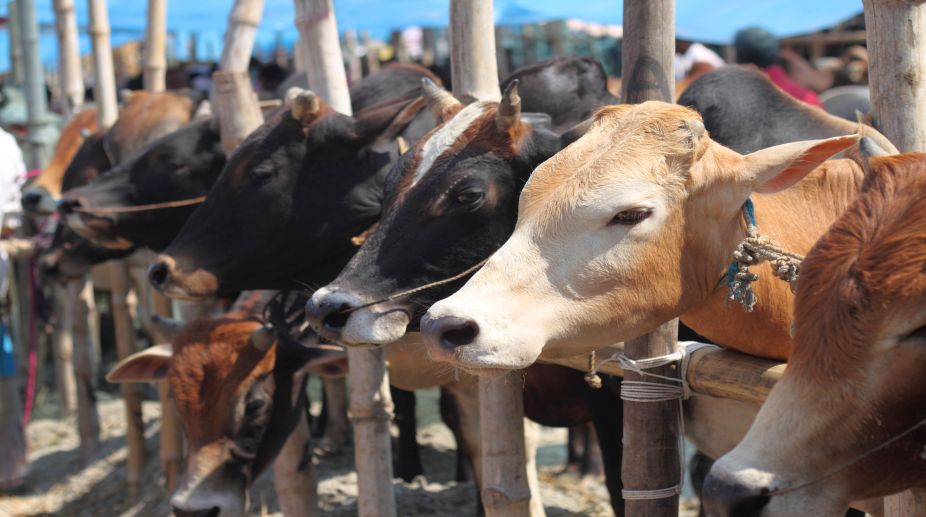
Dismay, fear and panic grips many in parts of India, as the ban on selling of meat that triggered dissension not only among the common people but also in the corridor of politics continues to be imposed in several states.
Recently, it was the crackdown on illegal slaughterhouses initiated by Uttar Pradesh Chief Minister Yogi Adityanath followed by other states like Jharkhand, Rajasthan, Chhattisgarh, Uttarakhand and Madhya Pradesh, and now the announcement of life imprisonment for cow slaughter in Gujarat.
Advertisement
Following it, the voice for and against the ban in social networking sites and mobile apps has been growing louder and wider. But the ban on cow slaughter is not a new issue, it has been debated upon in both the political and social circles even before, and it is an age-old matter.
The ban on cow slaughter is ancient
According to history books, cow slaughter became prominent in India when Islamic rulers of Arab and Central Asian Turkic arrived in the country. It was during the Mughal rule that selected restricted bans were introduced on cow slaughter. It was believed that Mughal emperor Humayan stopped eating beef after killing of cows in Hindu territory led to severe clashes. So, later other Mughal emperors like Akbar and Jahangir prohibited cow slaughter.
Where was India’s first slaughterhouse built?
While killing of cows and domestic animals was practiced openly, India’s first formal slaughterhouse was built in Calcutta, now Kolkata, in 1760 by Robert Clive.
What does the Indian Constitution have to say about beef ban?
Yes, in Directive Principles of State Policy, the Article 24 of the Indian Constitution states prohibition of slaughter of cows and calves and other milch and drought cattle. The milch and drought cattle include buffaloes, mithun and yak.
Where is cow slaughter legal in India?
Kerala, Arunachal Pradesh, West Bengal, Mizoram, Sikkim, Meghalaya, Nagaland, Manipur and Tripura are states where there are no restrictions on cow slaughter or sale of cows.
States where cow slaughter is banned
In Gujarat: According to the bill passed by the state Assembly on March 31, now it is life imprisonment for cow slaughter in the state from the earlier seven-year jail term. The bill also imposed 10 years' imprisonment for transportation of cows. People in possession of beef will be slapped a fine of Rs.1-5 lakh along with a jail term of 7-10 years.
In Uttar Pradesh, cow slaughter can lead to seven-year jail term with fine up to Rs.10,000.
In Maharashtra, slaughter or consumption of cow meat is banned and five years' imprisonment and Rs.10,000 fine of the accused.
In Jharkhand, Haryana, Jammu and Kashmir and Rajasthan – jail term of 10 years has been imposed on selling or consumption of beef. However, a fine of Rs.1 lakh is imposed for killing in Haryana and Rs. 50,000 in Chhattisgarh along with seven-year imprisonment.
In Tamil Nadu and Odisha, up to three years jail and two years jail along with Rs.1,000 fine in both the states respectively.
In Karnataka, possession of cows is not considered illegal, but killing can lead to seven-year jail and Rs.1 lakh fine. But, it is yet to become a law in the state.
In Madhya Pradesh, killing of cow would result in seven-year jail.
In Himachal Pradesh, killing of cows is allowed for only research purposes. But, otherwise anyone caught in the act of slaughtering cow for selling and consumption will be jailed for five years.
Cow slaughter is banned in Assam, except on ‘fit-for-slaughter’ certificate according to the Assam Cattle Preservation Act, 1950. Also in Andhra Pradesh and Telengana,
In Chandigarh, cow killing, storing or consuming beef is banned.
Cow killing is allowed in Bihar for the ones older than 15 years. However, slaughter of calves is banned. The violater will be slapped a jail term of six month and Rs.1,000 fine.
In New Delhi, slaughtering of cows, not buffaloes, and possession of beef even if killed outside the city is banned.