PM Modi greets Jharkhand on its foundation day
Prime Minister Narendra Modi on Wednesday greeted the people of Jharkhand on the state’s 17th foundation day and also paid…
The concept, developed by a Water BANK-incubated entrepreneur, uses bamboo for its high strength-to-weight ratio, rapid renewability and vibration-damping properties.




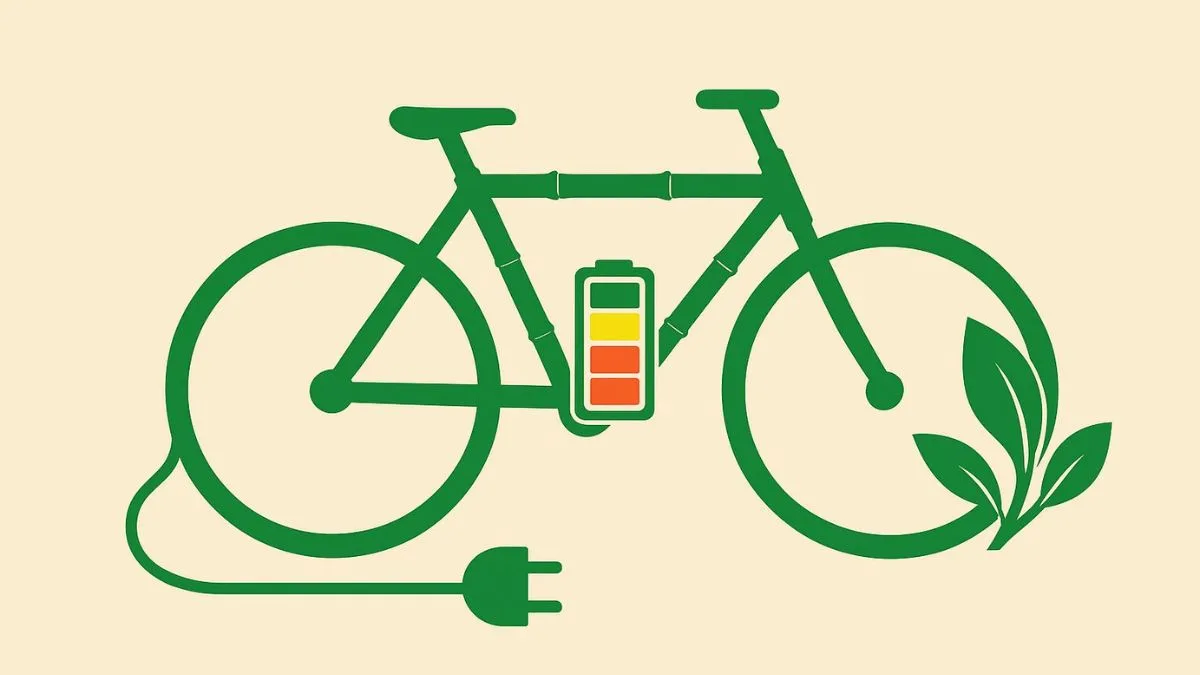
Photo: AI Generated
The Water BANK Foundation is developing what could become the world’s first electric bicycle with a frame crafted entirely from bamboo. The project is set to be launched on Jharkhand Foundation Day in November. It blends centuries-old craftsmanship with modern electric vehicle technology and aims to reduce the carbon footprint of conventional cycle manufacturing while offering an affordable and eco-friendly mobility option.
The concept, developed by a Water BANK-incubated entrepreneur, uses bamboo for its high strength-to-weight ratio, rapid renewability and vibration-damping properties. The model will feature pedal-assist speeds of up to 25 km/h, a range of 60 km per charge, minimal use of metal and plastic, and a modular battery system for easy replacement or recycling. A basic solar charging option is also being explored to make the bike nearly self-sustaining.
Advertisement
Saket Kumar, President of the WaterBANK Foundation Trust, said the aim is to combine local cycle repair know-how, traditional bamboo skills and advanced EV components into a do-it-yourself model costing just Rs. 15,000. “This is more than just an innovation,” he said. “It is a movement where nature, technology and community empowerment ride together.”
Advertisement
Industry experts believe the project’s weight-optimization approach could also transform electric carts for street vending. Abhinav Praveen, Vehicle Mechanical Systems Engineer at Mahindra, said, “Cracking the weight optimization strategy is the novelty which extends the range of electric carts without increasing battery cost or size. This could be a groundbreaking mobility solution for local vendors.”
Prakash Behera, Vehicle Electrical Systems Engineer at Mahindra, added, “By using lightweight materials like bamboo and designing around minimal energy consumption, the team reduced the total system weight by up to 60 percent. This directly translates to longer range, smaller batteries and lower daily operating cost, making sustainable electric mobility truly accessible for local vendors.”
Alok Kumar, Vehicle Dynamics Engineer at Suzuki, highlighted the efficiency breakthrough. “Offering a game-changing solution for street vendors, the team under Saket’s guidance replaced a conventional 800W e-rickshaw system with a sustainable 250W motor setup, both targeting 150 km range at 25 km/h. The 250W system required just 1.5 kWh battery capacity and performed optimally on a 50 kg bamboo frame, while the conventional 800W system needed 4.8 kWh and a 160 kg metallic frame.”
The bamboo e-bike will first be rolled out in Netarhat and Mahuadanr blocks of Latehar district, where bamboo craftsmanship is deeply tied to tribal heritage. WaterBANK plans to train local artisans to produce frames, turning traditional skills into a modern livelihood.
Public test rides are scheduled for November to mark the 25th anniversary of Jharkhand’s formation, with a formal international presentation planned at the UN Water Conference in Dubai in 2026. National and overseas launches are expected to follow.
If successful, the project could set a global precedent for how indigenous materials and traditional skills can power the next generation of clean mobility.
Advertisement