Witnessing the 6th Celebration of World Heritage Day by SHAM
“SHAM remains committed to being a platform where research meets practice, ensuring India’s living traditions find new strength.”
Sweta Das | Kolkata | June 9, 2026 6:14 pm
Photo: SNS
Consistent with previous years, this year too, on April 18, Kolkata witnessed the 6th celebration of World Heritage Day by Society for Heritage, Architecture and Management (SHAM) at 23A, Ram Ratan Bose Lane, Shyambazar.
SHAM is an organisation dedicated to preserving and restoring our ancient archaeological heritage, architecture, folk traditions, arts, and culture.
Advertisement
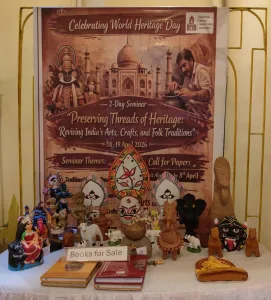
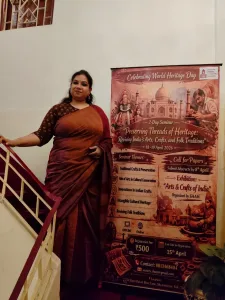
The President of SHAM and Professor(Retd), Department of Archeaology, University of Calcutta, Durga Basu, said in her address, “On World Heritage Day this year, SHAM celebrated the occasion under the theme Preserving Threads of Heritage: Reviving India’s Arts, Crafts, and Folk Traditions. Heritage came alive not just in monuments, but in the hands of artisans, in folk songs, weaving patterns, and stories passed down through generations.
Advertisement
At our 2-day seminar and exhibition on 18–19 April, we were honoured to have Prof. Ranjana Ray, Emeritus Professor and eminent scholar, who spoke on Cultural Heritage Management. Engaging discussions were held on diverse traditions including the Conch Shell Art of Bengal, Mural Art of Hazaribagh, Rangoli Art of Maharashtra, Masks of Eastern & North-Eastern India, Terracotta Temples of Baranagar, and Traditional Houses of the Meitei Community.
The dialogues, live demonstrations, and documentation reminded us that heritage is not just what we inherit — it is what we choose to keep alive. I thank all participants, speakers, artisans, and volunteers who made this celebration meaningful.
Photo: SNS
SHAM remains committed to being a platform where research meets practice, ensuring India’s living traditions find new strength. Let us remain the custodians our heritage deserves.”
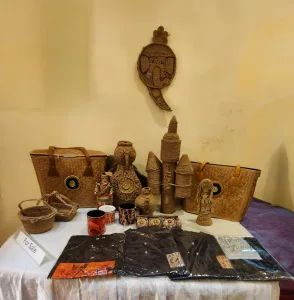
One of the exhibitors, Shiv, an alumnus of Painting and Museology from Rabindra Bharati University, showcased his personal collection of antiquities. Among the most significant artworks was the Kankroli Idol from the Dwarkadhish Temple (Jagat Mandir) in Dwarka, Gujarat. The 15-inch idol, carved from touchstone (Kashti Pathar), took three years to create. His other exhibits included terracotta fragments rescued from layers of cement, old miniature sandalwood toys for children, extinct conch shells of high cultural value, sandesh moulds made of fired clay, and a years-old collection of coins and stamps.
Shiv aims to recreate and conserve our lost heritage and to teach those interested in conserving and protecting our cultural legacy. He has opened an Instagram page named,The Charukriti where he takes custom orders for the restoration, recreation, and conservation of your ancient archaeological heritage.
Photo: SNS
What is the primary idea behind building SHAM?
The Treasurer of SHAM and Associate Professor & Area Chair -Finance, Army Institute of Management, Kolkata, Asmita Basu Chatterjee, said, “The primary idea behind building SHAM is to bring together academics, students, and research scholars who share an interest in heritage. To preserve our cultural heritage, we need many people from different disciplines, and SHAM provides a platform where they can connect. That was the main purpose, and it is an academic society. Our main objective is to disseminate knowledge and spread awareness about heritage sites and the rich cultural heritage of India.”
How should World Heritage Day be celebrated in the 21st century?
Asmita Basu Chatterjee states, “In this specific region and on this designated day, we should spread awareness among school and college students. Recognition through World Heritage Day or Heritage Week celebrations in November helps us connect with our heritage sites at every level. Several programmes are held in schools, colleges, and academic forums so that people become aware and try to preserve our resources.
In the modern era, the age of Artificial Intelligence, digitisation, and new technology these tools can be powerful for restoration. A lot of work is being done on how we can digitally preserve our heritage, whether through digital reconstruction of a site or digital preservation and documentation of ancient texts that would otherwise be completely destroyed. Certain heritage sites that are now destroyed are being digitally reconstructed with the help of historians, conservationists, and architects so that people can get a sense of how they existed in the past.
Hence, in the modern day, we should try to collect documents. This is not only the prerogative of archaeologists, conservators, or practitioners, it requires a multidisciplinary approach where people from technical backgrounds like civil engineering, architecture, mechanical engineering, and management can collaborate and formulate a restoration plan. That would be a new-age celebration of World Heritage Day, combining Science, Technology, Arts, and Management. We look forward to sustaining our heritage. Sustainability is the keyword today.”
Photo: SNS
What are the challenges of restoring old heritage architecture in the age of AI?
“In this age of AI, restoring heritage sites is a major challenge because people may use technology without understanding the cultural and architectural essence. I would repeatedly say that it is not only the work of AI specialists, digital reconstruction experts, or computer science professionals. They must consult specialists, archaeologists, historians, or architects who can advise how reconstruction should be done so that it is aesthetically consistent with the original heritage site, reflecting how the architecture existed in ancient times and how it can be re-visualised with digital tools.
This is the challenge without understanding the core and basics of such sites, many people attempt to digitally replicate and reconstruct artifacts. My suggestion is to consider the opinions and views of experts in the field as well. Let them work hand in hand with digital experts, historians, conservator-restorers, architects, and archaeology experts. I think it will yield an extremely fruitful result.”, Asmita Basu Chatterjee, comments.
What message do you want to give young history enthusiasts?
Asmita Basu Chatterjee conveys, “The first message I would like to give to heritage enthusiasts and budding scholars is this, understand and value your national treasures. If you come across any cultural site that is being damaged by weathering or human vandalism, try to document it and learn about its history and legacy.
I can realize it’s not always possible for an individual to protect and preserve a site because permissions and funding are major hurdles. Yet, if you can take a few photographs, write short notes, and gather more information, then disseminate it and spread awareness that this heritage site has high archaeological significance. Someone might take interest. Not many NGOs work in this area, and although government authorities do take care of heritage sites, they might become aware that this site is available for restoration and take initiative.
It is my earnest request to young scholars, please come forward and take interest in your culture and traditions. If we don’t recognize their value over time, we will lose these traditions and heritage sites. Even our intangible cultural heritage, Durga Puja has been recognized by UNESCO. It is one of our identities.
Similarly, the local heritage spots around you also create your identity. So please help spread archaeological awareness.”
A couple of weeks ago, on 18 April, the annual ‘World Heritage Day’ came and went almost unnoticed in Kolkata. It is usually a moment when a city looks at herself, at old buildings, inherited rituals, and spaces that remember more than people do.
The matter pertains to April 19, when some people had alleged that the students of BLS International School here were allegedly made to practice offering namaz in the school.